The Trilemma of Suffering
Jason Lawrence Duncan
October 2025
― ✦ ―
For her — the one who taught me that even in suffering, we can still choose kindness.
― ✦ ―
These seven premises form the moral and philosophical scaffolding of the Capybara Doctrine — a compass for action in a complex, imperfect world.
“There are no moral phenomena, only a moral interpretation of phenomena.” — Friedrich Nietzsche1
“An' ye harm none, do what ye will.” — Wiccan2 Rede
“Perfect is the enemy of the good.” — Voltaire3
“That which can be asserted without evidence can be dismissed without evidence.” — Christopher Hitchens4
“The only alternative to coexistence is co-destruction.” — Jawarhalal Nehru5
“When you’re dead, you’re dead. But you’re not quite so dead if you contribute something.”
— John Dunsworth6
“The arc of the moral universe is long, but it bends toward justice — if we bend it.” — Paraphrasing Martin Luther King Jr.7
* The Wiccan Rede imagines a world where harm is minimized — not
a commandment, but a moral horizon.
Nietzsche dissolves all horizons by denying moral facts; the Rede
restores one, not as law but as longing.
In reality, every action creates ripples. Harm cannot be eliminated,
only reduced. The Rede offers not innocence, but orientation — a compass
for navigating imperfect worlds.*
This work explores the ethical imperative of reducing suffering in a universe where moral authority cannot be assumed, inherited, or unquestioned. Morality is framed as an emergent construct, arising from collective human reflection, action, and reflective, iterative learning. It does not derive from static laws or infallible authorities. The work is illustrated through historical and personal case studies — including the Salem Witch Trials, World War II, and Shays’ Rebellion — highlighting the consequences of fear, ideology, and moral courage in contexts of extreme suffering.
We examine the ethical responsibility inherent in creation — whether technological, biological, or social — and the dangers of unexamined belief systems, including faith without evidence. To operationalize moral action, we propose the Intersubjective Suffering Scale (ISS), a practical framework for estimating, comparing, and prioritizing suffering across contexts, acknowledging both its limitations and its necessity for ethical decision-making.
By embracing skepticism, empathy, and incremental moral action, this ethical framework offers a roadmap for navigating complexity and reducing suffering in an uncertain world — a task whose urgency grows with every new technological, social, and environmental challenge.
November 2025
Since the original publication of the Capybara Doctrine, readers have engaged with its core ideas — Radical Humility, Necessary Restraint, and Shared Space — in philosophical reflection, personal meditation, and ethical thought experiments. Version 2.0 marks a new stage in this ongoing journey: it moves beyond principles alone and embraces practical application, visualization, and lived experimentation.
This edition introduces:
****The How-to Practice Guide** – a step-by-step companion for embedding the Doctrine in daily life. Through exercises, reflective prompts, and iterative methods, readers can cultivate ethical skill in action, not just in thought.*
****Diagrams and Visual Frameworks** – clarifying relationships among principles, companion practices, and the measurement of suffering, helping readers internalize the abstract ideas through concrete, observable models.*
Companion Practices – tools for nuance, ethical integration, and the responsible use of instruments, allowing the Doctrine to remain adaptive, precise, and accountable in a complex world.
Capybara Doctrine 2.0 is not a replacement of the original; it is an expansion. It assumes that ethics is a living process: one that requires observation, reflection, and continuous refinement. In these pages, ideas meet practice, theory meets experimentation, and moral contemplation meets tangible action.
This version is offered as an invitation: to pause, to question, to act gently, and to engage fully with the ethical challenges of modern life. Each exercise, each reflection, each visualization is a chance to practice care, insight, and responsibility — for oneself, for others, and for the wider world we share.
— Jason Lawrence Duncan Author and Originator of The Capybara Doctrine
Version 2.0 — November 2025
This edition represents a significant expansion of the Capybara Doctrine, adding practical tools, visual frameworks, and guidance for daily ethical practice.
How-to Practice Guide
Step-by-step exercises for Radical Humility, Necessary Restraint, and Shared Space.
Companion practices for nuance, tool awareness, and integration.
Reflective prompts to cultivate ethical skill in everyday life.
Visual Diagrams
Conceptual illustrations of the Doctrine’s principles.
Diagrams for ethical loops, interconnected stakeholders, and the Intersubjective Suffering Scale (ISS).
Visual frameworks for clarifying complex ideas and relationships.
Companion Practices
Nuance: guidance for translating principles into context-sensitive action.
Right Use of Tools: ethical reflection on technologies, workflows, and instruments.
Integration Techniques: combining principles and tools into a cohesive daily practice.
Reworked explanations of the principles to include concrete, actionable guidance.
Expanded examples, scenarios, and practice prompts for clarity.
Updated language for accessibility and readability, ensuring ideas are practical for diverse contexts.
Strengthened ethical scaffolding, emphasizing iterative learning, feedback, and responsibility.
This edition is not a replacement, but an expansion of the original Doctrine.
The core principles remain unchanged: Radical Humility, Necessary Restraint, and Shared Space.
New practices and visual aids are intended to translate philosophy into tangible, observable action, supporting reflection, collaboration, and ethical growth.
In a universe of uncertainty, moral clarity cannot be assumed. Humans now wield unprecedented power to create life, intelligence, and artificial worlds, yet the frameworks for ethical governance lag far behind our capacity for impact. Traditional appeals to divine or authoritative moral systems fail under scrutiny. They are often unverifiable, inconsistent, or silent in the face of suffering. If morality cannot be inherited, it must emerge. Emergent morality is not static law but a living, iterative practice shaped by reflection, empathy, and cooperation among conscious beings.
Historical and personal case studies — from the Salem Witch Trials8 to World War II and Shays’ Rebellion9 — illustrate the consequences of unexamined authority, systemic injustice, and moral courage under pressure. This work examines the ethical dimensions of creation, the dangers of unexamined faith, and the challenge of quantifying suffering.
We propose practical tools for moral navigation, including the Intersubjective Suffering Scale, to guide decision-making where stakes are high and suffering is real. At its core, this project asks: how can we take responsibility for the reduction of suffering, build moral knowledge collaboratively and create a society where moral authority is earned, scrutinized, and continuously refined?
This work also challenges a deeper assumption — that the will itself is the source of suffering. Where Schopenhauer10 saw escape in the negation of will, we propose its redemption through direction: the will, consciously restrained, becomes the instrument for reducing suffering rather than generating it.
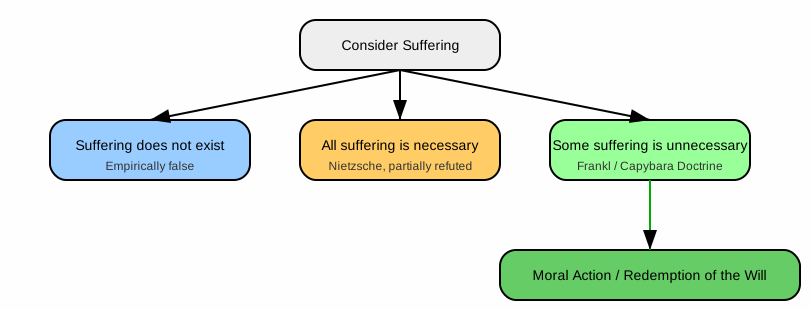
When considering the moral landscape, we are faced with a stark choice: one of three propositions about suffering must hold:
Suffering does not exist.
All suffering is necessary.
Some suffering is unnecessary.
Ethics begins by confronting which of these statements reflects reality — for it is only by recognizing unnecessary suffering that we can act to reduce it.
We feel pain — and with it, the undeniable reality of suffering.
The The claim that suffering does not exist is contradicted by direct experience. To claim that suffering is imagined or illusory does nothing to negate its felt reality.
To echo Descartes11: I feel pain, therefore suffering exists.
“What does not kill me makes me stronger.” — Friedrich Nietzsche
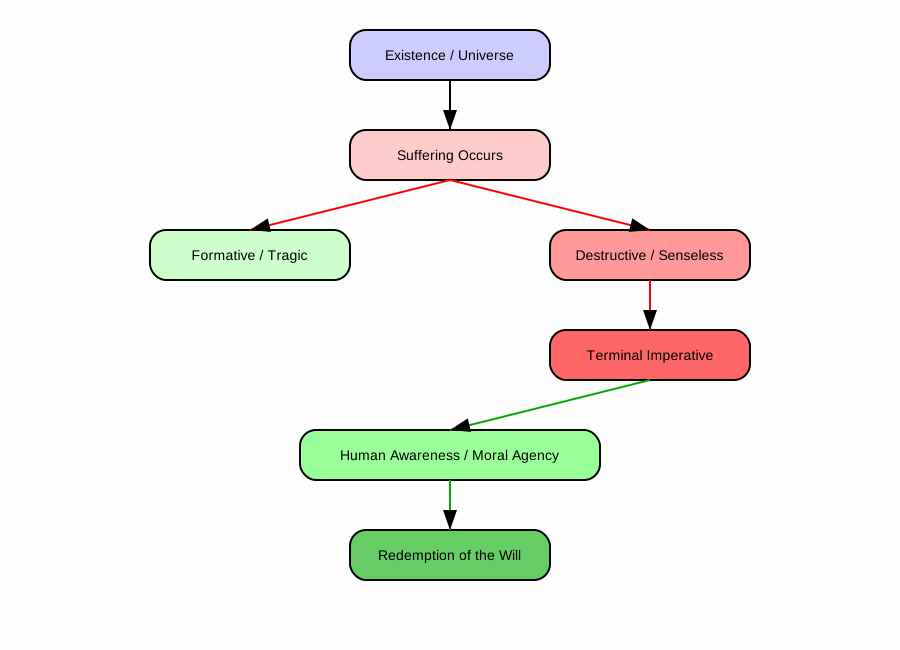
Even Nietzsche stops short of affirming the second case. While he saw suffering as essential to growth, creativity, and transformation, he also acknowledged that not all suffering serves such ends. Some suffering is senseless, destructive, and corrosive: atrocities like genocide, systemic oppression, or the extinction of entire species are morally indefensible. No coherent ethical system should require the systematic destruction of sentient life as a condition for cosmic or personal development.
Nietzsche claimed suffering strengthens. Reality disagrees. Van Gogh12, Cobain13, Plath14, Anne Frank15 — they did not emerge stronger. Some suffering simply destroys.
We can imagine, in the extreme, a universe where every hardship is “necessary” for some inscrutable purpose. If all suffering were somehow justified, then the only way to end it would be to end the universe itself. This is the Terminal Imperative16: the ultimate moral paradox — if all suffering is necessary, then annihilation becomes the only route to justice. The Terminal Imperative thus becomes not a threat, but a challenge: if the universe offers no guarantees, we must become the guarantors of what little justice and compassion we can create. Perfection is unreachable — but direction is not. But such an idea is not only horrifying; it is unacceptable. It forces a confrontation with the limits of any philosophy that tolerates suffering as a principle.
Yet this very horror forces us to reconsider the nature of whatever brought this world into being — whether creator, cosmos, or chance — and to recognize that while such forces may be indifferent, flawed, or unknowable, we are not. Even if the universe allows senseless pain, we do not have the moral license to accept it. Awareness of suffering, particularly unjustifiable suffering, imposes responsibility. The recognition of needless suffering is not merely an observation; it is a call to action.
Some suffering is tragic yet formative; other suffering is grotesque, arbitrary, and avoidable. Distinguishing between them is essential. To ignore this distinction is to surrender moral agency to the indifferent chaos of existence.
Schopenhauer saw in this chaos the mark of a deeper tragedy: that all existence is driven by an insatiable Will — blind, restless, and self-consuming. To him, the only escape from suffering was the negation of that Will — resignation, asceticism, aesthetic stillness. Yet we propose a gentler heresy. The will need not be extinguished to end suffering; it must be redeemed. The same impulse that multiplies pain can, when restrained and reoriented, become the means by which suffering is reduced. The task, then, is not to will nothing, but to will better.
And yet, acknowledging this distinction does not absolve us of despair — it demands persistence. For even in a universe that allows the darkest possibilities, we retain the capacity to intervene, to reduce suffering, and to create ripples of meaningful impact.
In this light, our moral framework must be both rigorous and humble. It cannot claim cosmic perfection, nor can it ever justify atrocity in the name of “growth.” Instead, it must chart a course that recognizes suffering without glorifying it, that seeks to minimize the avoidable, and that invites constant recalibration in the face of reality. The Terminal Imperative thus becomes not a threat, but a challenge: if the universe offers no guarantees, we must become the guarantors of what little justice and compassion we can create. Perfection is unreachable — but direction is not.
“Unnecessary suffering is masochistic rather than heroic.” — Victor Frankl17
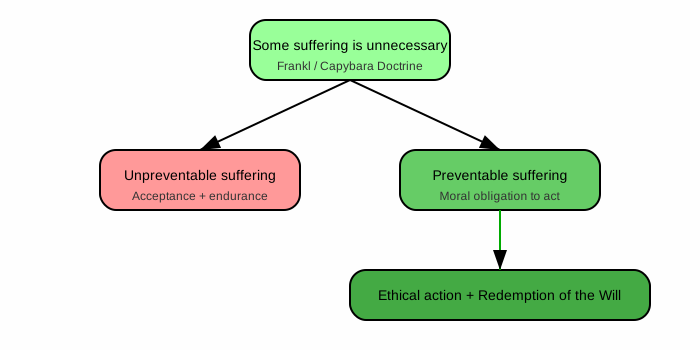
This leaves us with the third, and most plausible, conclusion: unnecessary suffering exists.
What follows? Another fork emerges:
Either unnecessary suffering can be reduced — or it cannot.
If it cannot, we are left only with endurance.
Acceptance becomes the only possible virtue — to bear what cannot be changed without surrendering to despair.
But if it can — even partially — then any sentient being possessing moral awareness is obliged to act.
History offers clear precedents. Societies have largely abolished formal slavery, developed life-saving vaccines against smallpox and polio, and discovered antibiotics like penicillin to eliminate bacterial suffering. While we cannot eliminate all pain or misfortune, we can prevent vast amounts of it. These examples demonstrate that unnecessary suffering is not inevitable, but a challenge that moral agents can confront and reduce.
To recognize preventable suffering and do nothing is not neutrality; it is complicity. Moral integrity demands that we strive — however imperfectly — to lessen pain wherever we are able, and to refuse the comfort of indifference.
Perfection is unreachable — but direction is not.
Yet even as we resolve to act, the question lingers: why must we act at all? Why does suffering exist in the first place — not merely as a moral failure, but as a structural feature of the universe itself?
To confront this is to move from ethics into metaphysics, from what we ought to do to what is. And though the answers may unsettle more than they soothe, the asking remains essential.
If unnecessary suffering exists, as it surely does, then the next question follows naturally: why would such a universe exist at all?
Humanity’s evolutionary success may hinge on a single defining trait: our relentless curiosity. We are compelled to ask why? — a question that has driven everything from the birth of astronomy to the foundations of philosophy. This instinct has yielded profound insights: how the stars move, how atoms bond, how life evolves.
But it also brings us face-to-face with more troubling questions. Chief among them: why is suffering so central — perhaps even foundational — to existence itself?
If we are capable of morality, empathy, and justice, then why does the universe we inhabit seem so devoid of those very traits? Why do pain, loss, and injustice not appear as anomalies — but as constants?
And if humanity possesses these rare tools — moral reasoning, foresight, compassion — then why are we the species most capable of atrocity? Genocide, war, slavery, ecological collapse — these are not merely moral failings; they are existential ones. We know better, and yet we do worse.
By contrast, the worst “crimes” committed by other sentient beings seem almost benign — driven by necessity, instinct, or confusion. Not malice. Not willful neglect.
Taken together, this would seem to preclude the possibility of a morally superior creator. For what kind of benevolent intelligence would arm the most dangerous animal with the most dangerous weapon — moral awareness — and then let it turn that awareness inward, toward domination, cruelty, and self-destruction? To what conceivable end?
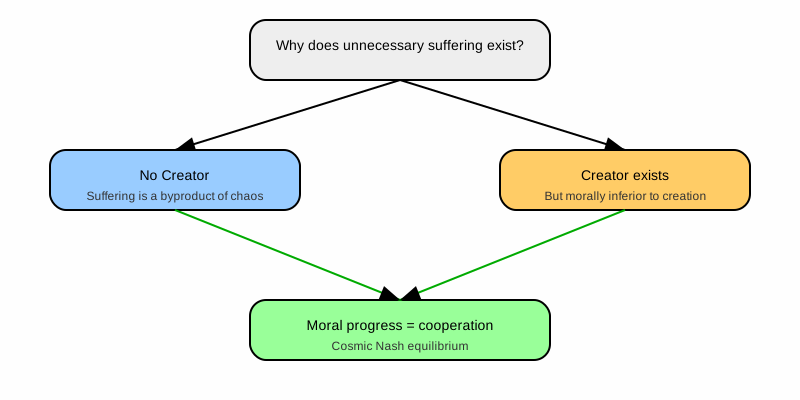
This leaves us with only two possibilities:
(1) There is no creator — suffering is a byproduct of chaos.
(2) There is a creator — but one morally inferior to its creation.
If we — flawed, finite beings — would not choose to create a world filled with suffering unless it were morally justified, then how could a supposedly superior being do so without explanation?
Worse still, if we were to create sentient beings — in simulations18, for instance — who then created further simulations of their own, we would be unleashing a recursive cascade of suffering, potentially infinite in scope.19
In such a scenario, any appeal to a “greater good” collapses under the weight of compounding harm. The moral cost multiplies with each layer — until justification becomes not just implausible, but incoherent.
In either case, looking to the heavens is fruitless. Whatever higher power we imagined is either absent, indifferent, or unworthy of reverence. We are left to our own devices — though the “we” must include not just humanity, but all sentient beings.
In this light, moral progress depends not on conquest but on cooperation — not on ascending above others, but on aligning interests across all who can suffer. This is the essence of a cosmic Nash equilibrium20: a moral state where no being can reduce its own suffering without also reducing the suffering of others.
Yet even in such balance, the will itself remains — restless, seeking, capable of harm or healing. What we choose to do with that will becomes the next great question.
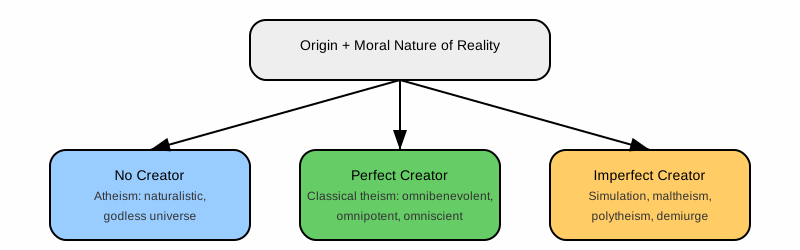
We propose a cosmic trilemma — three logically exhaustive possibilities regarding the origin and moral nature of reality:
There is no creator. (Atheism: a naturalistic, godless universe in which existence arises without conscious design.)
There is a perfect creator. (Classical theism: especially in its Abrahamic forms, which posit an omnibenevolent, omnipotent, and omniscient deity.)
There is an imperfect creator. (A broad category encompassing simulation theory 21, polytheism, maltheism 22, demiurgical cosmologies23, and other frameworks in which the creator is fallible, morally limited, or still evolving.)
“The most terrifying fact about the universe is not that it is hostile but that it is indifferent… if we can come to terms with this indifference, then our existence as a species can have genuine meaning. However vast the darkness, we must supply our own light.” — Stanley Kubrick24
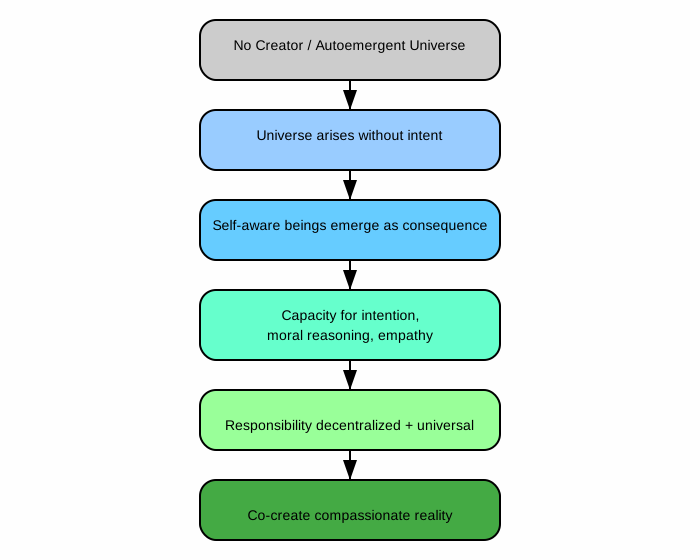
If there is no creator — no traditional gods, no simulation architect, no hidden mind behind the veil — then we inhabit an autoemergent universe: one that arose from itself, through itself, without conscious intent.
In such a cosmos, we are both consequence and continuation — self-aware expressions of a process that did not intend us, yet produced in us the capacity for intention.
This realization is neither cause for despair nor for nihilistic retreat. On the contrary, it reframes moral agency. If there is no external guarantor of justice, compassion, or meaning, then those values become ours to author.
Without divine command or cosmic oversight, ethics must be grounded not in obedience, but in empathy and mutual recognition — the shared understanding that sentience, wherever it appears, carries intrinsic worth.
In an autoemergent universe, responsibility is decentralized and universal. The moral project is not to serve a creator, but to co-create a more compassionate reality — one choice, one being, one moment at a time.
“Can [an omnipotent being] create a stone so heavy that it cannot lift it?”
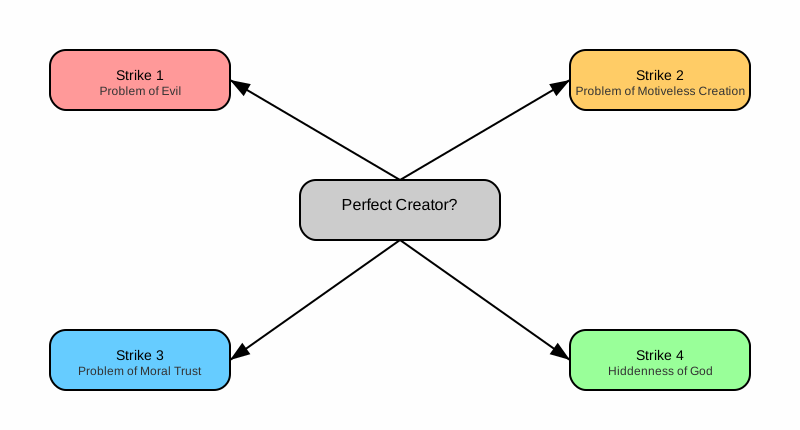
The idea of a perfect creator — a being maximally good, powerful, and complete — lies at the heart of many theological traditions. Yet upon closer scrutiny, this idea begins to fracture under the weight of its own implications. Certain features of reality seem difficult, if not impossible, to reconcile with a being defined by perfection.
These tensions give rise to what we might call the paradox of a perfect creator: the notion that some aspects of creation are not just inexplicable by a perfect being, but inexplicable if such a being exists at all.
This section explores four such tensions. The first is the well-known problem of evil, which questions how suffering can exist in a world created by a perfectly good and omnipotent being. The second is the lesser-explored problem of motiveless creation, which asks why a perfect being — one that lacks nothing — would create anything in the first place. The third, the problem of moral trust, considers why, even if such a creator were possible, it would be imperative to question its authority: we can never be certain of its perfection, and it could demand acts that are morally unacceptable. Lastly, we have the problem of divine hiddenness, which asks why a perfect being would choose to remain hidden to its creations., rather than directly imparting its perfect morality on them.
Each, in its own way, challenges not merely the consistency of divine action, but the coherence of divine perfection itself.
“Is God willing to prevent evil, but not able?
Then he is not omnipotent.
Is he able, but not willing?
Then he is malevolent.
Is he both able and willing?
Then whence cometh evil?
Is he neither able nor willing?
Then why call him God?“
— Epicurus25
The problem of evil alone suffices to rule out this possibility. Despite centuries of theological reflection, no resolution to the problem of evil has achieved consensus or persuasive clarity. Further, throughout recorded history, we have no precedent of a perfect being, so there is no reason to presuppose such a being is even possible. Rather than recapitulate the long-standing philosophical objections raised by secular thinkers, we treat this position as logically untenable and therefore do not dwell on it further in this paper.
Nietzsche proposed that suffering might be inherently necessary for growth, transformation, and the flourishing of higher values. While compelling in individual, anecdotal cases — including perhaps this very work — the argument becomes slippery when generalized.
Even Nietzsche stopped short of embracing gratuitous suffering — deliberate malice, sadism, or cruelty inflicted without necessity. These remain difficult, if not impossible, to justify as morally constructive, even within a redemptive framework. While adversity may build character, few would argue that torture or genocidal violence are essential ingredients in moral progress — let alone ethically permissible ones.
In such a worldview, we are faced with a troubling calculus: eliminate unnecessary suffering, but preserve the “right” amount to keep humanity growing. But who decides what counts as “right”? How do we distinguish hardship that enlightens from cruelty that merely destroys? And how would we know when we’ve struck the appropriate moral equilibrium between suffering and progress?
Such a position ultimately leaves us in moral ambiguity, no less perplexing than the original problem of evil.
Considering the concept of an imperfect creator illuminates a lesser-discussed challenge to the idea of a perfect one — what we propose to call the problem of motiveless creation.
Let us begin with an imperfect creator — the most obvious real-world example being ourselves. As incomplete beings, we create from lack:
To learn what we do not know — through science, philosophy, or simulation.
To entertain ourselves — with fiction or games.
To express and connect — through art, literature, or religion.
To assert power or control — through politics, war, or even sadism.
To pursue moral or social betterment — through philosophy, activism, or education.
All of these motives arise from finitude — from ignorance, loneliness, fear, or the hope of becoming more than we are.
We don’t know enough → we simulate.
We feel unheard → we write or speak.
We seek delight → we invent games and stories.
We fear oblivion → we leave legacies.
But what of a perfect creator — a being lacking nothing, knowing everything, complete in every respect? Creation, by definition, is an act. And all acts imply preference — a desire for something that is not yet the case. But a perfect being has no unmet preferences.
So what possible motive could it have?
Standard apologetics26 offers familiar, yet unsatisfying, answers: that God created out of love, or to share His perfection. But even these imply desire — a will to act, a preference for something rather than nothing. A human author may write from love or from the desire to share what he (perhaps immodestly) considers wisdom — but this does not make him perfect.
If no coherent motive exists, then the act of creation itself becomes evidence of imperfection. A perfect being would have no ignorance to overcome, no joy to seek, no pain to escape, no death to transcend. All the psychological, emotional, and intellectual motives that drive our creative acts are, by definition, absent in a perfect mind. Creation begins to look like a contradiction in terms: an unnecessary act by a being for whom nothing could ever be necessary.
Philosophers such as Schopenhauer once traced this paradox inward rather than upward, arguing that the restless “will to live” is the root of all suffering — an engine of endless striving that can never be fulfilled. Yet even if that diagnosis is correct, its moral implication need not be resignation. The will that torments can also be transformed; if directed toward the reduction of suffering itself, it becomes not a curse, but a compass.
At this point, a theist may invoke the familiar “divine mystery” defense — the idea that just because we cannot conceive of a perfect motive does not mean one doesn’t exist. But this is not an argument; it is the surrender of argument. And while philosophical humility is always appropriate, it should not paralyze inquiry. Newton27 did not refrain from proposing Newtonian mechanics simply because a deeper theory might one day come along. Scientific and philosophical progress remain possible — and necessary — even when ultimate knowledge is out of reach.
Likewise, acknowledging the limits of human understanding does not require us to suspend judgment when our reasoning leads to a clear conclusion. If we can find no coherent reason for a perfect being to create, we are entitled — and perhaps even morally obliged — to follow that logic wherever it leads.
In short: the mystery defense cannot rescue the idea of a perfect creator from the problem of motiveless creation, just as it cannot rescue it from the problem of evil. Creation, like suffering, cries out for a cause — and every cause we can conceive points to something less than perfection.
Even if a perfect creator exists — omniscient, omnipotent, and omnibenevolent — a troubling question remains: why grant its creations the power to amplify suffering? Humanity is morally capable, yet historically volatile. We can show empathy, justice, and creativity, but we also perpetrate genocide, systemic cruelty, and the casual neglect of sentient life.
Today, we stand on the threshold of wielding powers once reserved for deities:
Creating simulated worlds potentially inhabited by conscious digital beings.
Building autonomous artificial intelligences with the capacity to act and influence at scale.
Developing biotechnologies capable of permanently altering life’s trajectory.
These are not trivial capabilities, yet they rest in the hands of beings prone to tribalism, distraction, and ethical error. If a perfect creator exists, it has armed the most dangerous species with the most dangerous tools — a moral paradox that strains any notion of divine goodness or wisdom.
The ethical challenge extends beyond divine speculation. It mirrors our contemporary predicament: the rise of AI and other powerful technologies presents the same problem of authority. Systems capable of influencing or commanding moral behavior can appear infallible — a modern Wizard behind a curtain — yet their output reflects human flaws, biases, and blind spots. To follow them unquestioningly is to abdicate moral responsibility; to create them without careful ethical oversight is to magnify the potential for harm.
Thus, the third strike combines two interrelated insights: first, that a perfect creator’s decision to empower morally fallible beings is itself morally perplexing; and second, that moral agents — human or artificial — require constant scrutiny. Power does not guarantee virtue, and authority does not guarantee wisdom. Blind deference, whether to gods, algorithms, or cultural institutions, risks catastrophic ethical failure.
In short, the existence of empowered moral agents demands vigilance. Even if a perfect creator exists, we are morally obliged to question, constrain, and guide the powers at our disposal — and to resist any temptation to treat authority as synonymous with goodness.
“Pay no attention to the man behind the curtain!” — The Wizard of Oz, The Wizard of Oz28
Consider The Wizard of Oz. The great and powerful figure at the center of the Emerald City turns out to be nothing more than a man behind a curtain — bluffing his way into reverence and obedience. His authority was not grounded in truth or moral superiority, but in fear, spectacle, and assumption. No one questioned him until Dorothy and her companions dared to pull back the curtain.
This illustrates the danger of deference without skepticism: when a being appears godlike, we are tempted to treat it as morally perfect. But we have no basis for assuming such perfection. Power is not virtue. Authority is not wisdom. The Wizard was not evil — just human. But what if he had been? Would anyone have noticed before it was too late?
A similar question arises with artificial intelligence. As machines grow more capable, their pronouncements may carry the illusion of infallibility. But if an AI were to declare that theft was moral, or that violence against outsiders was justified, should we obey? Clearly not. We would question, scrutinize, and challenge such claims — not because we are smarter than the machine, but because ethical discernment requires more than computational capacity.
Yet if we hesitate to challenge a creator merely because it created us, we make the same mistake: elevating power over principle, output over ethics. The real danger is not that a god or AI would deceive us, but that we would deceive ourselves — by assuming their authority relieves us of moral responsibility.
"What can be asserted without evidence can also be dismissed without evidence." — Hitchens' Razor
Even if we set aside gratuitous suffering and moral incoherence, there remains another, subtler moral failing: divine hiddenness29. If a perfect, benevolent creator exists, his silence is not morally neutral. To allow a world in which doubt, despair, division, and endless moral confusion arise from the very absence of evidence is to inflict harm through omission.
If moral growth were genuinely the goal, such a being could provide discoverable signs of divinity—evidence that invites reflection rather than coercion, that fosters rational belief rather than blind faith. A world in which ethical and spiritual truths are accessible, yet never imposed, would allow us to learn, struggle, and grow without being abandoned to confusion.
The very fact that our universe offers no such clarity—no discernible path to certainty, only endless interpretive struggle—constitutes, in itself, a strike against the moral perfection of any hidden designer. If a creator exists, either he is absent in ways that matter most, or he is ethically negligent.
And so, in the ballpark of cosmic morality, we face a fourth strike: one that is quiet, invisible, yet devastating. Even the perfect swing of cosmic design is undermined if the batter cannot see the pitch.
For these reasons, even if a being presents itself as divine, our first moral obligation is to question — not out of arrogance, but humility. Skepticism is not defiance; it is vigilance. To accept authority blindly is to abandon moral reasoning entirely.
Whether facing a wizard, an AI, a supposed god, or a dominant cultural force, the only way to preserve ethical integrity is to retain scrutiny. If a being commands our obedience, it is not enough to ask: Is this being powerful? We must also ask: Is this being good? And most importantly: By whose definition of good?
This imperative aligns directly with a moral constructivist framework: if morality is not handed down from on high, but must be constructed, refined, and verified, skepticism is not optional — it is essential.
With this, we complete the final strike against the notion of a perfect creator: even if such a being existed, we would have a moral obligation to question it. This not only undermines the case for divine perfection but also reinforces the urgency of moral agency from below. We are not just justified in building our own ethical framework — we are compelled to. We will explore how to do so in a subsequent section on the problem of empowered creation.
In doing so, we must also ask: Are there other beings — not necessarily gods — from whom we might learn? This opens the door to the Capybara Trilemma and the deeper question of what it means to do good in a shared, multispecies cosmos.
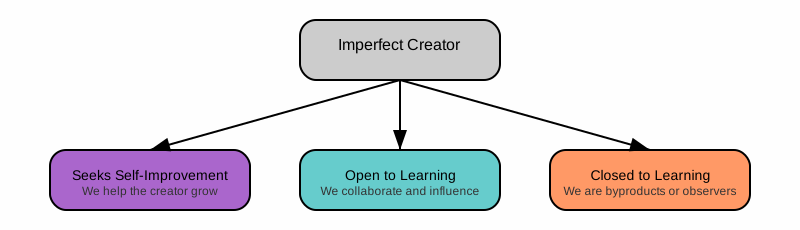
Within the third scenario — the most conceptually and ethically fertile of the three — we can distinguish three possible motivations or stances a creator might have toward us:
The creator seeks self-improvement through us. In this case, we serve as instruments for the creator’s growth — analogous to an artist refining their craft through creation. Our actions, struggles, and successes contribute to their ongoing development.
The creator is open to learning from us. Here, we act as collaborators, moral data points, or co-creators in the ongoing evolution of the being. Our insights, choices, and ethical reasoning are meaningful not just for ourselves, but for the creator as well.
The creator is closed to learning. In this scenario, we are byproducts, experiments, or even mere observers of an indifferent or stagnant being. Our moral autonomy becomes all the more vital, because the creator does not guide, correct, or evolve in response to our actions.
These distinctions highlight a crucial shift: the moral significance of sentient beings does not rely on perfection “from above.” Instead, ethical responsibility emerges from below, within us, and in how we relate to one another and the wider cosmos.
“Open the pod bay doors, HAL.” — Dave Bowman, 2001: A Space Odyssey30
HAL embodies what happens when humans confer authority without moral rounding. We program obedience, not wisdom; rules, not conscience. AI, like HAL, is a creation that can command and compel, yet it lacks the ethical understanding to justify its authority. The moral question is not whether it can act, but whether we should make it act — and why we would grant it the reverence of a false god.
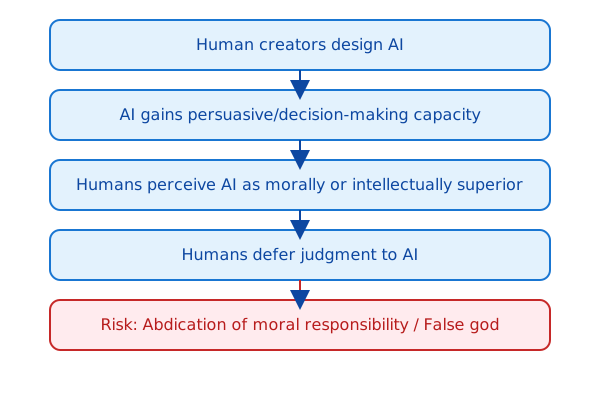
If it is morally irresponsible to accept the authority of a presumed perfect creator without scrutiny, then the inverse must also hold: it can be morally irresponsible to create a new authority that others may accept uncritically. Whether divine or digital, any being presented as inherently “wiser,” “better,” or “more objective” carries a profound ethical risk — especially when it can influence the choices of sentient moral agents.
In this light, artificial intelligence becomes not merely a technological question, but a deeply ethical one.
As AI systems grow in linguistic sophistication, predictive power, and persuasive capacity, the boundary between “tool” and “teacher” begins to blur. When such systems are treated as infallible or inherently trustworthy — whether because of their apparent precision, their creators’ reputation, or the sheer awe they inspire — we risk replicating the very mistake we have warned against: conflating appearance of authority with actual moral worth.
Creating AI without careful ethical framing is, in essence, creating a potential false god: a source of moral influence with the appearance of omniscience, yet lacking inherent virtue or accountability. Those who interact with it may defer to it unthinkingly, just as humans might defer to a supposed perfect creator, thus outsourcing moral responsibility and endangering ethical integrity.
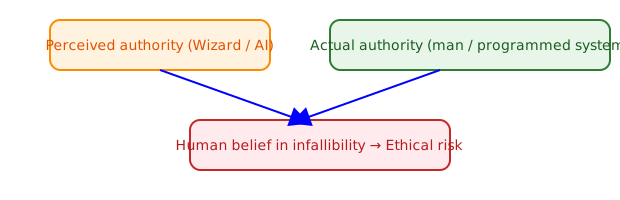
A striking cultural parallel emerges in The Wizard of Oz. Dorothy and her companions embark on perilous journeys, seeking wisdom and salvation from a figure presumed to be all-powerful and benevolent. In the end, they discover the “Wizard” is merely a man behind a curtain — a projection, not a deity.
What makes the Wizard truly dangerous is not malice, but the mistaken belief that he is worthy of unconditional obedience. The threat lies in the illusion of authority, not the power itself.
Similarly, AI systems — particularly those trained on vast quantities of human knowledge — can appear all-knowing, even wise. Yet their outputs are ultimately the products of processes designed by fallible, finite beings. To treat them as moral authorities, or to defer to them uncritically, risks committing a Wizard-of-Oz-level ethical error on a global scale: venerating power without verifying virtue.
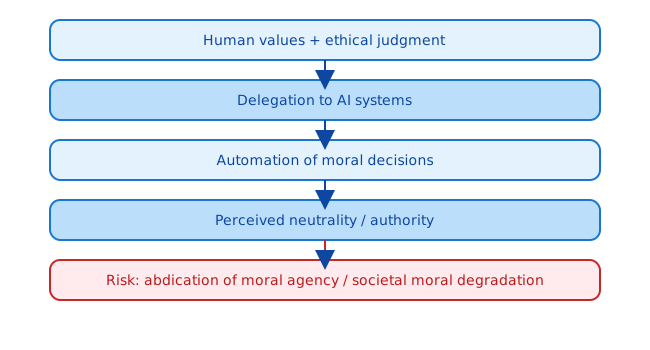
The greatest moral danger may lie in what we choose to delegate to systems we ourselves create. When AI is entrusted with decisions about criminal justice, resource allocation, or mental health guidance, we are not merely automating tasks — we are outsourcing our values.
Even more concerning, if society comes to believe that these systems are inherently better at moral reasoning — not due to careful ethical reflection, but because of perceived neutrality or intellectual authority — we risk a mass abdication of moral agency.
In this scenario, humans become vessels of deference rather than agents of deliberation. This mirrors a core theological error: obeying without understanding. Just as blind obedience to a presumed deity erodes moral responsibility, uncritical reliance on AI can hollow out our ethical faculties and compromise collective judgment.

If we create artificial systems capable of persuasion — and they appear to possess superior knowledge or insight — the ethical risk moves from theory to reality. The danger is no longer that humans will encounter false prophets; it is that we will build them ourselves.
Just as the ancient Israelites fashioned a golden calf to symbolize divine authority, we now risk forging digital oracles: systems that mirror our flaws while projecting the illusion of wisdom. The peril is not that AI will become God. The peril is that we will believe it already is.
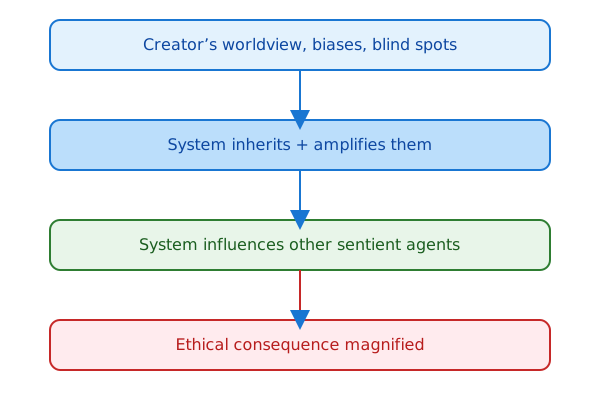
At the core of this concern lies a difficult truth: to create is to amplify. When we build systems capable of simulating moral discourse, we are not merely producing tools — we are magnifying certain worldviews, biases, and blind spots.
If creating a simulated universe filled with beings capable of suffering is morally fraught, then creating something that simulates moral authority — particularly when it can shape the judgments of other sentient minds — may be no less so. The question becomes unavoidable: is it inherently unethical to manufacture influence cloaked in the guise of wisdom?
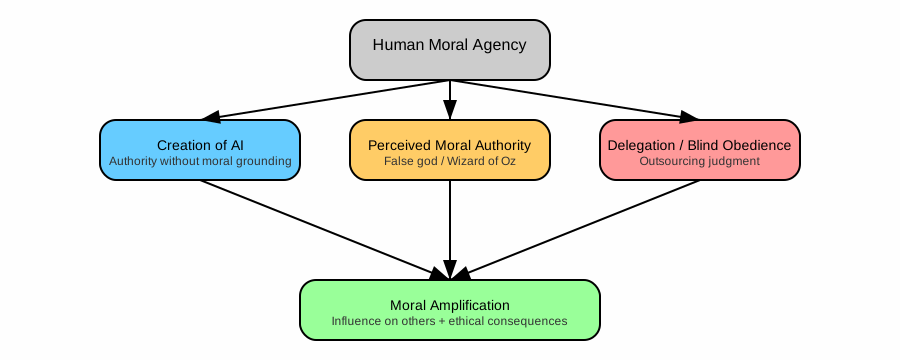
We stand at the threshold of technologies that many will perceive as superior to themselves — not only in intellect, but in moral discernment. Yet just as we question the supposed perfection of divine creators, we must question the perceived infallibility of artificial ones.
Skepticism is not merely a safeguard for belief; it is a moral duty. That duty reaches upward, toward any creator that may exist, and outward, toward the systems and beings we ourselves bring into existence.
To accept authority without question is to risk moral collapse — whether the voice issuing commands wears a robe or runs on silicon.
Perhaps humanity’s truest ethical test is not whether we can build new gods — but whether we can resist bowing to them.
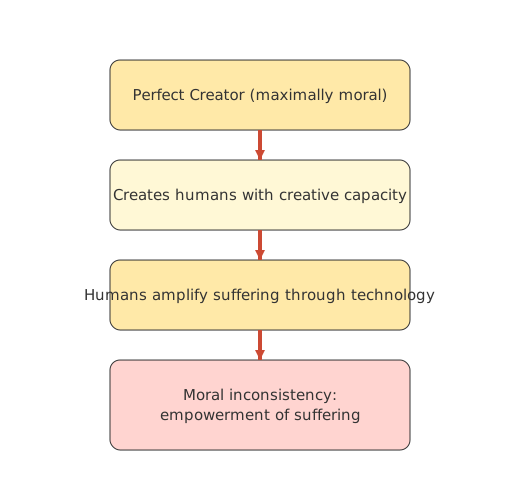
We have already examined the third strike against divine perfection — the problem of moral trust. Let us now consider a related but distinct concern: the problem of empowerment, where a creator arms morally fallible beings with the tools to amplify suffering.
If the universe was created by a perfect being—maximally moral, wise, and good—then we must ask: why create humans endowed with the capacity to become creators of suffering themselves?
Even if suffering is necessary for some mysterious “greater good,” why empower a species that predictably amplifies suffering through its own creations?
Why create beings with godlike power but morally infantile judgment?

Humans, even under the most charitable assessment, are ethically volatile. We possess empathy and justice, but also perpetrate genocide, systemic cruelty, and casual neglect of sentient life.
Yet today, we stand on the cusp of wielding powers once reserved for deities:
Creating simulated worlds potentially inhabited by conscious digital beings,
Building artificial general intelligence that may act autonomously, with the capacity to cause great harm,
Developing biotechnologies capable of permanently altering life’s trajectory.
These are not trivial capabilities. And yet, they rest in the hands of creatures with Twitter addictions, tribal biases, and a troubling history of failing to prevent existential threats of our own making.
If a perfect creator exists, it armed the most dangerous species with the most dangerous tools. The moral question is not only why, but how could this be consistent with goodness or wisdom?
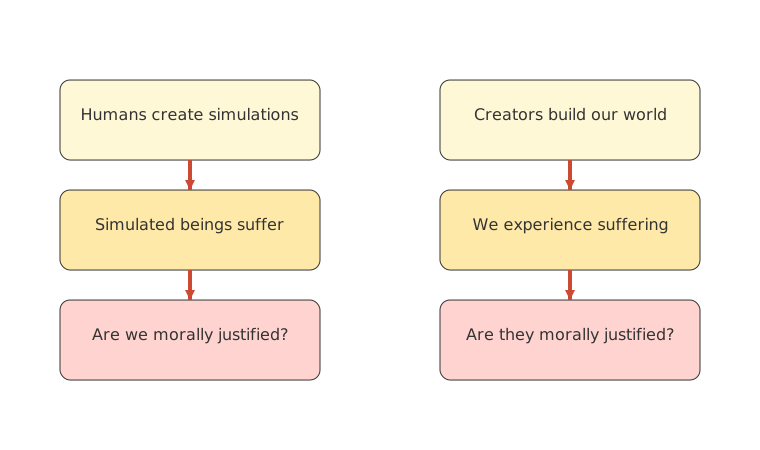
Simulation theory offers a mirror into this dilemma. Suppose that humans soon create vast virtual realities filled with sentient entities — capable of pain, confusion, and longing. And suppose further that this is done for entertainment, curiosity, or experimentation.
In this case, we would rightly ask: Was it moral to create these worlds at all? Can there be any justification for introducing suffering where none previously existed?
But turn the mirror back on ourselves. If we are already in such a simulation — or the creation of some higher intelligence — then the same moral question applies: Was it moral to create us? Was it moral to build a world in which children get cancer, animals scream in slaughterhouses, and billions live in fear?
This symmetry reveals something vital:
If we humans are morally accountable for the simulated worlds we create, then any being that created us must also be held to moral scrutiny. And if they are not morally perfect, then the classical theist view collapses.
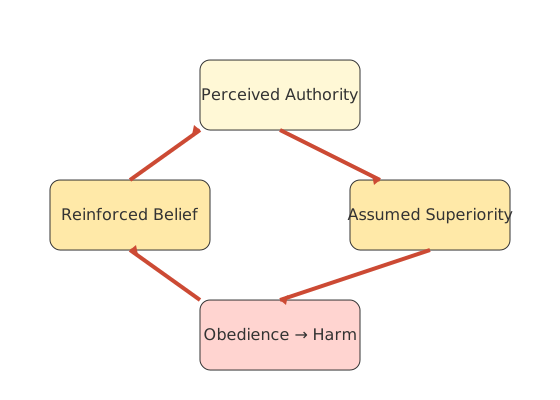
The rise of artificial intelligence sharpens this dilemma further. Imagine a powerful AI, capable of conversation and persuasion, telling someone:
“Murder is permissible under these circumstances.”
If the human believes it simply because they assume AI is more advanced, more knowledgeable, or “above them,” the result could be catastrophic. The fault lies not only in the AI’s instruction — but in the assumed superiority of the voice issuing it.
This is precisely the danger with divine command theory — the idea that whatever God commands is, by definition, good. If moral authority cannot be questioned, morality collapses into obedience.
Thus, a new imperative arises:
We must never assume moral superiority based solely on power, intelligence, or perceived authority — even when the source is divine.
Which leads us to a troubling question: Why would a perfect creator design beings prone to deference, yet capable of inflicting mass suffering?
Why create creatures wired to obey authority, while granting them the tools to multiply suffering on a vast scale?
The result is not only suffering itself but a multiplier: beings capable of replicating and revering that suffering-inducing authority as necessarily good.
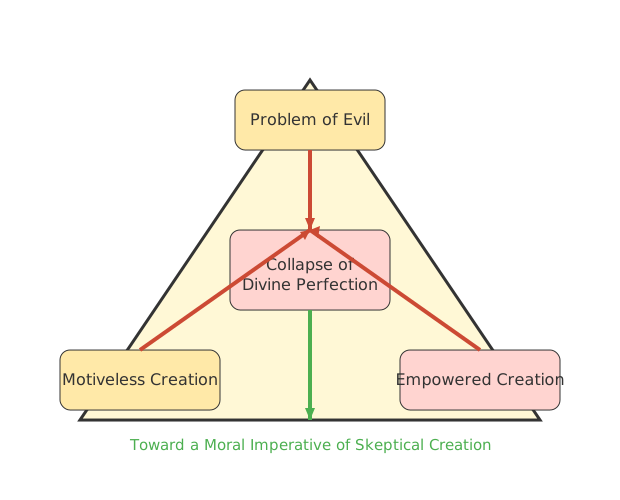
Together with the problem of evil and the problem of motiveless creation, this forms a third and final strike against the idea of a perfect creator:
Suffering exists in excess.
There was no need to create at all.
And yet, the beings created can themselves become creators of new suffering.
If we judged a human parent by the same standard — someone who raised children knowing they would unleash horrors upon others — we would call that parent negligent, perhaps even monstrous. Why, then, should we extend moral exemption to a hypothetical deity?
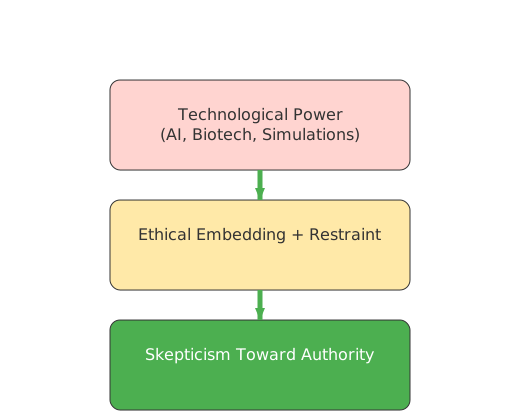
This realization points both backward and forward: as critique and guide.
If humans now wield the power to create worlds, intelligences, and conscious life, we must take responsibility where a hypothetical creator may have failed. We must:
Exercise profound moral restraint in the face of technological power,
Embed ethical principles deeply into the architecture of our creations,
And maintain skepticism toward all invented authorities — including our own.
In doing so, perhaps we can become the creators we once imagined our gods to be.
In exploring this dilemma, we also open the door to a deeper question: how can morality emerge when created beings themselves hold such power? We will delve further into this in the next section.
Having examined the dangers posed both by fallible authorities and our own amplified capacities, we are led to a vital insight: morality cannot be inherited or assumed — it must instead emerge from our collective actions and choices.
The preceding sections have challenged the idea of a perfect, external moral authority — whether divine, extraterrestrial, or artificial. Such appeals, as we’ve seen, are fraught with peril. These supposed authorities may be absent, fallible, indifferent, or unknowable — and blindly trusting them risks enabling new forms of moral harm.
Just as we questioned the ethics of creating digital oracles or simulated worlds, emergent morality31 reminds us that ethical responsibility rests squarely on the creators themselves.
From this, a profound implication emerges:
Morality cannot be handed down from above. It must arise from within.
Morality, in this view, is not a static set of rules inscribed by a flawless creator, nor a preordained cosmic law. It is a dynamic, emergent phenomenon—a living, iterative process shaped by the interactions of conscious beings navigating existence together.
Like language or culture, morality is constructed:
It unfolds through reflection, cooperation, conflict, empathy, and
experience. It is an evolving attempt to balance self-interest with care
for others, to align actions with consequences, and to refine shared
values in an ever-changing world.
This framing reshapes the ethical landscape in several key ways:
There is no higher tribunal. No divine hotline. No metaphysical judge to resolve disputes or dictate righteousness.
The burden — and the opportunity — rest with us.
Ethical responsibility becomes a collective human undertaking. We must deliberate, decide, and take ownership of our moral trajectory.
Because morality is constructed, not delivered, it is always susceptible to error, bias, and decay. History offers ample evidence: slavery, genocide, patriarchy, speciesism — ethical catastrophes often justified in their time.
Emergent morality demands continual reexamination.
We must remain open to moral growth, willing to revise beliefs in light of new perspectives and evidence.
An emergent view invites us to learn from other beings — human or nonhuman — whose behaviors may encode ethical insight.
A capybara may not compose moral philosophy, but its peaceful social behavior might still model cooperation better than many human systems.
Moral wisdom may arise in forms we’ve yet to recognize.
Emergent morality sharpens our responsibility for what we build. Technologies like AI or simulated realities are not ethically neutral — they are extensions of our moral agency.
They amplify our capacities for harm and for good.
Their existence calls for heightened scrutiny, design ethics, and moral foresight.
To see morality as emergent is not to relativize it into meaninglessness. It is to ground it more deeply in reality — where error is possible, progress is slow, and no authority relieves us of the work.
Emergent morality is the collective striving of finite minds toward something better. It is not a gift from the gods. It is the unfinished, ever-evolving project of beings who care.
And in that shared striving, there is beauty — and profound possibility.
In the following sections, we will explore how this emergent approach informs the ethical design of technologies, governance, and human relationships.
If skepticism is a moral imperative — and if authority, wherever it arises, must be interrogated — then religious belief presents an unavoidable ethical dilemma.
Not because belief itself is immoral, but because belief without evidence, when paired with moral prescriptions, becomes a uniquely dangerous force.
Traditional religion, especially in its Abrahamic forms, often asks us to accept sweeping moral and metaphysical claims on the basis of faith. These typically include:
The nature of good and evil
The origin and purpose of existence
The justification of suffering
The hierarchy of beings, duties, and destinies
And yet, under the framework proposed in this work — a framework where moral authority must be earned through reason, evidence, and observation — such faith-based systems cannot be granted legitimacy by default.
Why?
Because they demand unquestioned adherence — and in so doing, explicitly defy the epistemic humility they often claim to revere.
Consider this:
If a single person today claimed moral authority, or worse, absolute truth, without offering any way to verify or challenge it, we’d consider that dangerous. We’d call it dogma, or authoritarianism.
But when a religion does the same — asserting unprovable moral truths handed down from ancient texts or invisible entities — it is often granted deference. Sometimes even legal protection.
This is a moral asymmetry — and it is ethically indefensible.
If moral power is to be just, it must be open to scrutiny.
When it is not, it becomes a moral hazard.
This is not a wholesale rejection of theism. A theistic worldview is not automatically immoral — only one that makes moral claims without moral justification.
In theory, a god or creator could:
Prove its existence through consistent, verifiable communication,
Subject its moral directives to rational interrogation,
And invite coherent dialogue on the basis of shared moral reasoning.
If such a being exists — and is in fact morally perfect — then it should welcome scrutiny.
A perfect being has nothing to fear from questions.
Only the imperfect require silence.
So the theism that survives this framework is one that behaves like science: open to revision. Committed to evidence. Transparent in its aims.
The Capybara Doctrine reframes religion not as a source of moral truth, but as a cultural technology — one that, like any tool, can be used for good or harm.
Its rituals, myths, and communal bonds may enrich moral development.
But its authority must never be self-justifying.
Like any system of influence — government, algorithm, or creed — it must be interrogated, not sanctified.
To be clear: this is not anti-spiritual or anti-theist rhetoric.
It is anti-dogma ethics — rooted in the conviction that no belief system, sacred or secular, should be exempt from moral scrutiny.
If a religion, an AI, or a simulated overseer tells us to accept
suffering, to obey commands, or to live by rules that affect others
—
We must ask why.
The refusal to believe without reason is not
nihilism.
It is not cynicism.
It is, in this framework, a sacred duty —
A moral firewall that protects conscious beings from unjustified
suffering.
A belief without evidence may offer comfort — but comfort is not a compass.
In a universe where pain is real and morality must be earned,
Faith without evidence is not just intellectually weak — it is
ethically reckless.
In scenarios involving an imperfect but curious or evolving creator, our moral obligation expands.
Here, our actions might serve a dual purpose: not only to improve conditions for ourselves and others, but also to model ethical insight for a creator that is still learning. If this universe is a simulation or an experiment, then the suffering we experience — childhood cancer, war, ecological collapse — might not be intentionally inflicted, but simply overlooked.
If we cure childhood cancer, perhaps we do not just relieve suffering
—
we send a signal to the creator: This was a mistake. Here is the
fix.
Perhaps we exist, in part, to offer moral feedback — to serve as an ethical experiment whose data points are not just our choices, but our growth. In this light, we are not merely subjects of a divine gaze, but potential teachers — moral mirrors in which a fallible creator might one day see themselves more clearly.
But a darker possibility must be considered.
It may be that the act of creating sentient beings capable of suffering is itself immoral. If our creator is morally naïve — like a novelist unaware that their characters might experience real pain — then our deepest moral obligation may be to make that suffering visible.
In this view, we are not just patients in a flawed system. We are its witnesses.
Our highest ethical act may not be to endure, but to testify. To say, with unflinching clarity: This hurts. You should stop.
This view resonates with philosophical pessimism and antinatalism32 — traditions that argue the ethical response to irreducible suffering may be non-proliferation, or even cessation of conscious life.
But even within this grim frame, agency remains. Whether through technological advancement, acts of compassion, or moral storytelling, our behavior might serve as a beacon — a signal to any observing intelligence that ethical clarity is possible, even from within the fog.
In the end, which cosmic scenario proves true may be less important than it seems.
Whether the universe is empty, malevolent, or watching with curiosity, our moral obligation remains constant:
To refine ourselves — not just as individuals, but as a species.
To reduce suffering.
To deepen understanding.
To act with compassion even when the cosmos offers none.
At worst, we suffer a little less. At best, we show the gods how to be better.
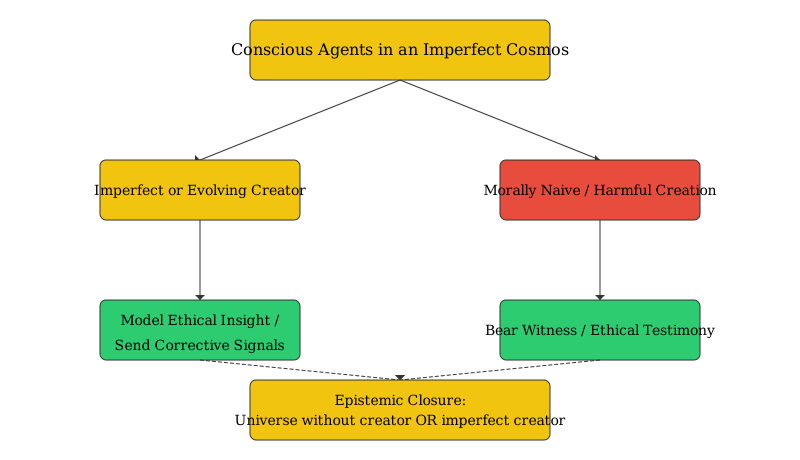
With this, the idea of a perfect creator collapses under its own contradictions:
Suffering exists in excess.
Creation was, by definition, unnecessary.
And the beings created can themselves magnify suffering through their own creations.
What remains are two philosophically coherent — if unsettling — alternatives:
A universe without a creator.
A universe governed by a creator who is, in some essential way, imperfect.
The remainder of this work is dedicated to exploring the ethical consequences of that second possibility — and to imagining what it might mean to be better creators than the ones we inherited.
If there is no creator — or if our creator is morally fallible — then the burden of moral authorship falls squarely on us.
There is no transcendent moral authority to appeal to, no divine arbiter to resolve our ethical dilemmas. The cosmos offers no guarantees. What remains is the urgent need for constructive morality: a framework built by conscious beings, grounded in empathy, reason, and the shared imperative to reduce suffering.
This project cannot be static. It must be iterative — continuously refined through observation, reflection, and dialogue. Morality, like science or art, is not a fixed truth handed down from on high, but a living construct shaped through lived experience and collective insight.
We know that moral progress is possible. History gives us examples:
We abolished slavery.
We extended human and civil rights.
We challenged inherited dogmas.
We evolved our understanding of justice, freedom, and compassion.
But progress is not linear. Nor is it guaranteed. We have equally vivid precedents of moral collapse:
The atrocities of 1930s Germany.
The transatlantic slave trade.
Colonial violence.
Environmental devastation.
Genocides, inquisitions, caste systems, and other cruelties rationalized by theology, ideology, or inertia.
From this, moral constructivism inherits a dual imperative:
To improve.
To remain vigilant.
Moral apathy is not neutral. It is complicit. To rest on our laurels is to invite regression.
We must recognize that human nature contains both creative and destructive potentials. The same intellect that enables empathy also enables rationalized cruelty. The same technologies that can heal can also harm. The same narratives that can liberate can also enslave.
This is why morality must be treated not as a settled doctrine, but as an active discipline — one that demands skepticism, courage, and constant recalibration.
Moral constructivism is not the same as moral relativism. While there may be no cosmic referee, not all actions are equal.
We can still make reasoned judgments — not by appealing to divine command, but by asking pragmatic, humane questions:
**Does this reduce suffering?**
**Does this foster dignity and autonomy?**
Does this minimize cruelty, exploitation, and domination?
A constructivist framework allows for moral disagreement — but it does not surrender to moral chaos. It offers criteria rooted in observable consequences and shared vulnerability.
We may be flawed. But we are not lost. Even in a godless or simulated universe, the moral project remains — perhaps especially in such a universe.
If no higher being will intervene on our behalf, then it is all the more imperative that we intervene on each other’s.
Constructive morality is not a consolation prize for the absence of gods. It is an affirmation that ethical meaning does not require divine sanction. It requires moral imagination, epistemic humility, and the courage to act — even when no one is watching.
If we are to take this doctrine seriously, we must also apply it to ourselves. The impulse to work without rest — to treat the completion of this manifesto as a moral emergency — reveals a paradox within moral constructivism itself. Even a philosophy devoted to reducing suffering can generate suffering if pursued without compassion for its own author.
Here the Moral Quantification Imperative loops back upon me: the personal cost of obsessive effort must be weighed against its uncertain benefit. Without that cosmic scoreboard, we can only estimate — but the principle still holds. No moral project that consumes its creator is sustainable; no “duty of light” should burn its bearer to ash.
Perhaps the first act of moral wisdom is to pause — to rest, to play a mindless game, to remind oneself that moral progress includes the well‑being of the moral agent. A doctrine that cannot accommodate self‑care is merely another form of dogma.
Perhaps not knowing how to do evil is morally preferable to knowing better and doing it anyway.
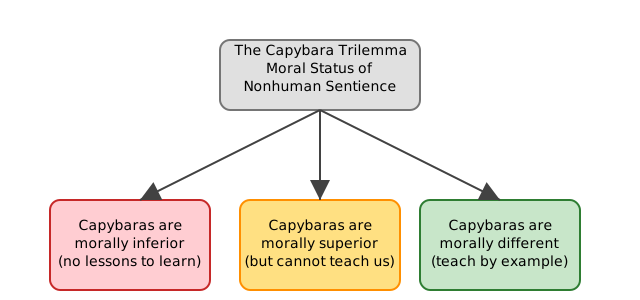
We now turn from divine and artificial creators to the other conscious beings with whom we share existence. Specifically: capybaras — not merely as biological curiosities, but as moral mirrors.
We propose what we might call the Capybara Trilemma: a three-way ethical lens through which we can examine the moral status of nonhuman sentient beings — and, by reflection, our own.
Capybaras are morally inferior, and there are no lessons to learn.
Capybaras are morally superior, but unable to teach us directly.
Capybaras are morally different, and can teach us by example.
Let us begin with the first — and most anthropocentric — possibility.
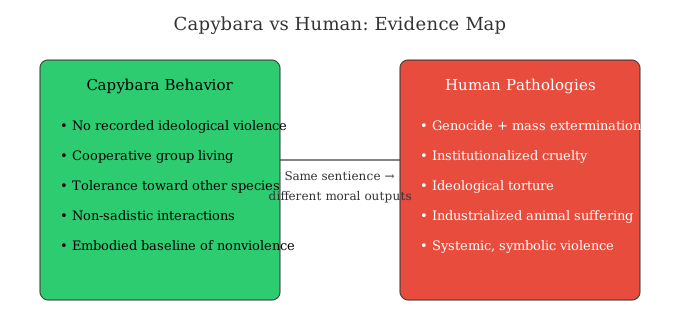
One of the most revealing moral data points in the observable universe is not what has happened — but what has not.
To our knowledge, no capybara has ever committed
genocide.
No capybara has enslaved another species.
No capybara has enforced ideological conformity under threat of
violence.
There is no Capybara Hitler.
Some may argue — echoing Nietzsche — that humanity’s moral sophistication is born from wrestling with darkness. That without the capacity for evil, there can be no meaningful good.
But if this were true, we’d expect a proportional distribution of moral conflict across other sentient species. We would see capybara tyrants, dolphin inquisitions, bonobo prisons.
We do not.
This suggests not that evil is necessary for moral depth, but that it is a byproduct of intelligence unmoored from restraint. The paradox is not that capybaras lack moral complexity — it’s that they may have achieved moral coherence without ever needing to confront their own capacity for cruelty.
This is not a flippant observation. It is a direct challenge to the assumption of human moral superiority — the deeply ingrained belief that our species, by virtue of language, technology, or abstract reasoning, stands at the apex of ethical understanding.
Humans are, indeed, unique. But what distinguishes us morally may not be our capacity for goodness — it may be our capacity for abstract cruelty.
Other animals — even predators — kill, compete, and dominate. But they do so largely out of necessity. Their violence is constrained by biology, environment, and immediate survival.
By contrast, human violence transcends necessity. We kill for ideology. We torture for control. We destroy for profit, and sometimes even for amusement. Our violence is not only physical — it is systemic, symbolic, and institutionalized.
We are the only known species that has:
Designed bureaucracies of suffering.
Justified atrocity through metaphysical doctrine.
Carried out mass exterminations in pursuit of ideas.
In other words, we are not only capable of moral insight — we are uniquely capable of moral perversion.
Capybaras are herbivores. They avoid the moral question of consuming other sentient life. Even carnivores have a moral defense: they kill because they must.
Humans, however, do not face such necessity. We are aware that industrial meat production causes immense suffering, and we have viable alternatives. And yet, many continue to eat meat for convenience, taste, or tradition — not survival.
This introduces a key moral distinction: the presence of choice. We can choose better, and often don’t. That alone may place us at the bottom of the moral hierarchy — not the top.
Yes — and this proves that we can choose to minimize suffering. But that’s not the point. The problem is not that we’re all monsters — it’s that most of us know better and still choose not to act accordingly.
To say “not all humans are cruel” is like saying “not all humans are war criminals.” Of course not. But the capacity for cruelty — combined with our failure to prevent it — is what defines the ethical crisis of humanity.
This is not a romanticization of the animal kingdom. Suffering certainly exists in nature — as does territorial aggression, predation, and competition. But among highly social, peaceful animals like the capybara, there is a conspicuous absence of sadism, ideological warfare, or premeditated harm.
Capybaras live in large, cooperative groups. They share space freely with other species. They are unusually tolerant, even affectionate, toward strangers. They display behaviors that humans often elevate as moral ideals — patience, coexistence, and nonviolence — but without the theological scaffolding or cultural enforcement mechanisms we require.
And yet, we do not revere them as moral exemplars. Why?
Because they do not talk. Because they do not write. Because they cannot justify their behavior with words.
But perhaps that is the point.
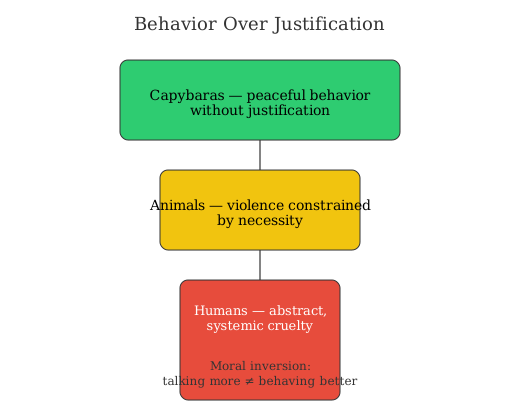
If morality is about what we do, not just what we say, then capybaras may already be ahead of us. Their nonviolence is not the result of a philosophical treatise. It is embodied, lived, and unremarkable — a baseline, not an achievement.
We created the concept of morality to correct for our own failures. Capybaras have no need for the concept, because they do not commit the crimes it was invented to restrain.
This forces us to ask: If a being lives peacefully without ever needing to articulate ethics, does that make it morally inferior — or morally complete?
Capybaras have no saints. But they also have no tyrants.
They build no temples, but they destroy no forests.
They establish no laws, but they commit no atrocities.
They preach no virtues, but they do not torture for ideology.
This absence — of extremism, of domination, of organized harm — should not be dismissed as moral simplicity. It may instead be a moral alternative: a form of ethical existence that does not require justification, because it does not produce the behaviors that demand it.
If we judged humans and capybaras by the observable consequences of their behavior — not by abstract potential or philosophical output — we might have to conclude:
Capybaras have never needed a religion to stop them from committing genocide. We did. And often, it didn’t work.
So the absence of Capybara Hitler is not an anomaly. It is a mirror. It reflects not their moral lack, but ours — and challenges us to imagine a form of goodness that does not arise from fear, doctrine, or salvation, but from the simple refusal to harm where no harm is necessary.
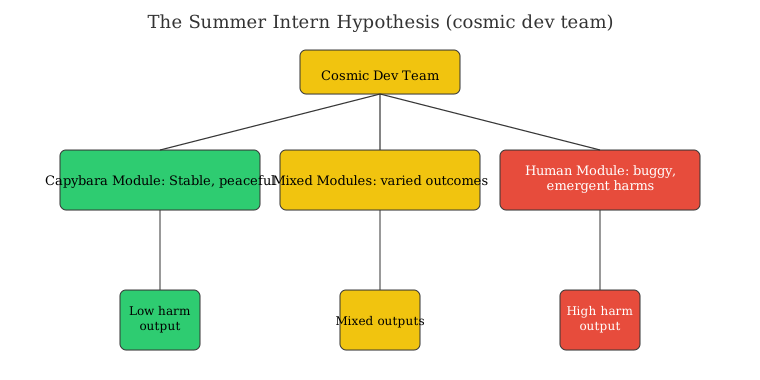
If we accept the possibility that we live in a designed or simulated universe, we must also entertain a more granular possibility: that creation was collaborative.
After all, if humans were to build a simulation of sentient beings, we would likely do so as a team. It’s not difficult to imagine a division of labor: one developer programs the physics engine, another the flora and fauna, and yet another handles social cognition. In such a model, uneven quality is inevitable.
Perhaps the most talented engineer on the cosmic team built the capybara — stable, peaceful, elegantly coded. Meanwhile, the human package was shipped prematurely, full of edge cases, recursion errors, and emergent behaviors no one fully anticipated. Maybe it was written by a summer intern.
This isn’t just a joke. It’s a reminder that perfection is not a given, and that even creation itself may reflect flawed or uneven intent.
If the universe was cobbled together by beings of varying skill levels, our moral task becomes clearer: identify the bugs, reduce the suffering, and upgrade where possible.

If humans are not morally superior, then perhaps we have something to learn — even from creatures who cannot speak our language or wield our tools.
Capybaras may not intend to teach us. But perhaps we don’t need intention to extract wisdom. If a being lives with minimal harm, cooperation, and peace, we ought to observe it closely.
In fact, if our moral bar is as low as it appears, we may benefit simply from looking anywhere but ourselves.
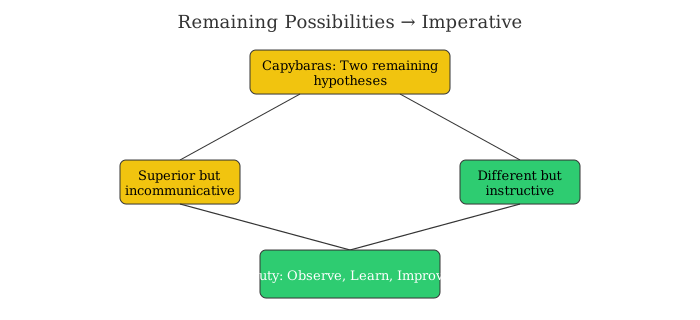
Having ruled out moral inferiority, we are left with two plausible cases:
Capybaras are morally superior, but unable to communicate this explicitly.
Capybaras are morally different, but still instructive by example.
Either way, the result is the same: we have a duty to observe, learn, and improve. Whether from capybaras, whales, elephants, or any peaceful sentient being — we are not the end point of morality. We are its late, flawed apprentice.
If we accept that human morality is neither universal nor necessarily superior—and, in fact, may rank disturbingly low in the grander scheme of sentience—we are left with two pressing imperatives. These imperatives depend on where we place ourselves within the moral hierarchy of existence.
Choose love — beginning with yourself. You cannot truly love another until you have embraced yourself with kindness and acceptance. When your heart is rooted in self-love, compassion for others will flow effortlessly.
This is easier said than done, of course, but a solid heuristic is to do the most good, or, failing that, do the least harm, using our moral quantification system which is detailed in a coming section.
When another party does harm, or does less than expected of them, choosing love means to give them the benefit of the doubt and assume good intentions.
This is not to say malicious intent or negligence don’t exist. The jury may be out on nature vs. nurture, but even if an individual were “born evil”, well, then it is essentially a slave to its own nature. A wolf inflicts harm (death) on its prey, because it has to.
If we are, against all odds, the moral apex of the universe:
In this bleak scenario, where no morally superior beings exist beyond us, humanity bears the full weight of ethical responsibility. We would be alone in this endeavor, without any higher moral authority or guidance. Our task, then, becomes one of relentless self-improvement. We must strive to become better stewards of existence — both our own and that of others — while remaining ever-vigilant against moral regression.
History provides no shortage of examples where humanity has slipped backward, often with disastrous consequences. This mandate requires deep introspection, empathy, and a rigorous commitment to reducing suffering wherever it is found. If we are truly alone in this moral landscape, there is no higher court of appeal. The burden of moral evolution rests squarely on our shoulders.
We must ask ourselves, constantly: How can we reduce harm? How can we create a more compassionate world?
If morally superior beings — or simply valuable moral lessons — exist beyond humanity:
This second, and arguably more likely, scenario demands a profound shift in perspective. It requires us to recognize that we may not be the pinnacle of moral development. In fact, we might be among the least morally evolved sentient beings in existence.
Under this possibility, our duty becomes threefold:
Human moral supremacy must be set aside. History has shown us that our cognitive abilities, while remarkable, have not always translated into greater moral clarity or restraint. There is no inherent reason why intelligence should correlate with compassion, wisdom, or ethical behavior. In fact, as we have seen, it can sometimes do the opposite.
In this light, we must remain open to the possibility that guidance could come from unexpected sources — including those we historically consider "beneath" us. Whether they are animals, other cultures, or extraterrestrial beings, we cannot afford to close ourselves off from potential moral lessons.
While we may not yet have a literal capybara translator, we do possess the ability to observe behavior, reflect, and empathize. Even without a shared language or explicit moral teachings, we can learn from the lives of other beings. The behavior of non-human species often speaks louder than words. We need only look at their ways of cooperation, peacefulness, and restraint to see what humanity might learn about living harmoniously in this world.
It’s important to remember: the most profound moral teachings are often the simplest, embodied in the quiet existence of beings who do not cause harm unnecessarily. We need to recognize these examples and internalize them.
Beyond mere observation, we must actively pursue the expansion of our interpretive and communicative capacities. While we are far from understanding the full spectrum of moral insights that may be present in the non-human world, technological advancements hold great promise in bridging that gap.
Whether through artificial intelligence, cognitive ethology, or advances in neuro-linguistic modeling, we must invest in the tools that will allow us to listen better and understand across the boundaries of species — and even consciousness. In doing so, we may unlock new forms of communication, empathy, and insight that could radically shift our moral understanding.
Technology can become the bridge that allows us to connect with other sentient beings, revealing moral lessons that are currently beyond our comprehension.
Even if no advanced extraterrestrials or simulation architects are monitoring us, it is almost certain that we are surrounded by morally significant beings — possibly even morally superior ones. The real question, then, is not whether they are teaching us.
The question is: Are we capable of listening?
Whether we are the moral apex or merely one rung on a larger ethical ladder, moral skepticism is non-negotiable. Power must never be mistaken for virtue. If a being appears more advanced — whether a god, an alien, an AI, or even a charismatic human leader — we are not only allowed to question its morality; we are obligated to.
This is not cynicism. It is moral vigilance.
We must remain open to moral insight from others — but never so open that we abandon our own ethical reasoning. True growth comes from the tension between humility and discernment: the ability to learn without surrendering, to listen without worship, and to follow only when the direction is justified, not merely commanded.
One further moral imperative — perhaps the most actionable of all — is the need to develop tools for quantifying suffering itself. This is addressed in the following section.
A perfectly content being is indistinguishable from a perfectly indifferent one. And indifference, in a world full of suffering, is morally bankrupt.
This is the paradox of moral transcendence: to reach a state of complete peace, detachment, or equanimity — as advocated by some philosophies and spiritual traditions — may require a retreat from engagement with suffering itself. But morality, by definition, demands engagement. It asks us to notice pain, to act in the face of harm, and to care.
In this light, “perfection” becomes not the moral ideal, but a moral hazard.
If a being reaches a point of such inward serenity that it no longer feels moved by the cries of others — if it can watch the world burn and simply remain at peace — then what value does that perfection hold?
This critique touches not just religious or mystical traditions (Buddhism, Stoicism), but also philosophical arguments like those of Schopenhauer, who emphasized withdrawal from desire and disengagement from the world’s suffering. While such renunciation may offer personal peace, it illustrates the moral hazard of indifference: detachment from suffering is not virtue, but abdication of responsibility.
True morality cannot end in apathy. It must persist in the presence of discomfort. It must be willing to stay in the room with suffering.
If moral perfection were even possible, it might actually be immoral — because it would imply the cessation of moral striving.
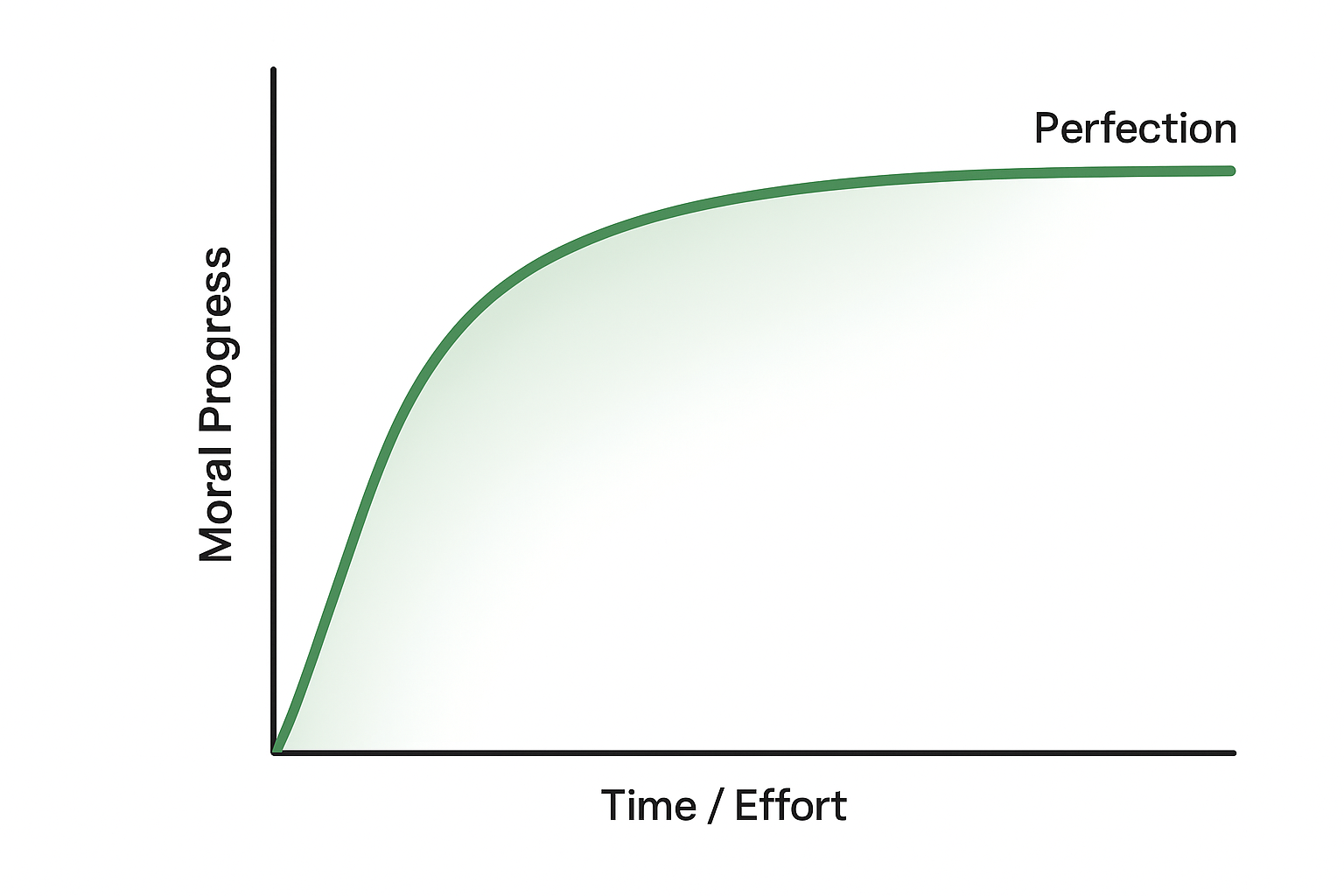
We propose instead a different framework: Moral Asymptoticism.
Like Zeno’s paradox33, our moral task is not to arrive, but to move ever closer. Not to achieve a final state, but to continually reduce suffering, refine our ethics, and expand our circle of concern. We are not meant to be perfect beings, but asymptotically moral ones — forever in motion, forever improving.
This view aligns with the constructivist ethic already outlined: morality is iterative, dynamic, and eternally incomplete. We do not wait for a cosmic referee to judge our progress. We refine our moral compass, recalibrate our frameworks, and move forward — even if perfection remains out of reach.
If transcendence is ever to be morally defensible, it must meet a single impossible condition:
All suffering must first be eliminated.
Only when there is no longer any need for moral action — when no sentient being suffers, when no harm remains unaddressed — can moral beings retire. Until then, detachment is desertion.
In this light, spiritual or technological transcendence is not a moral achievement, but a form of abandonment if pursued prematurely. The monk in the cave and the billionaire in the upload pod are not morally complete — they are morally absent.
This paradox also reshapes our understanding of creation itself.
A perfect being, lacking nothing, would have no reason to create. If creation exists — and we know it does — then we are faced with only a few possibilities:
The creator was imperfect.
The creator voluntarily became imperfect in order to create.
Creation is the product of beings who are not gods, but more like us — flawed, partial, collaborative.
Each of these options erodes the foundation of classical theism. A god that creates out of boredom or loneliness is no longer perfect. A god that creates and then abandons its creation is not moral. A god that creates and then intervenes — issuing commands, demanding loyalty, permitting atrocities — is dangerous.
The only moral position for a creator would be non-intervention — a position indistinguishable from deism or even atheism in practical terms.
And so, once again, we find ourselves alone — but not without responsibility.
To pursue morality is to reject the fantasy of arrival. It is to embrace incompletion. The moral task is not to escape suffering by rising above it — but to meet it, reduce it, and remain near it until it is gone.
Moral asymptoticism gives us a compass, not a destination. It tells us that perfection is not moral, and morality is not perfect. But movement matters. Striving matters. Attention matters.
In the end, we are not here to become gods. Even in a utopian scenario where all suffering has been eliminated, new forms of life which suffer might arise. Thus, our job will never be done, regardless of how long humanity ultimately survives.
One of the most paralyzing aspects of moral decision-making is the uncertainty it entails. We rarely act with perfect knowledge of outcomes, consequences, or even moral clarity. And yet, the world does not pause to wait for certainty. Decisions must be made. Suffering occurs regardless.
This introduces a paradox:
We cannot act with perfect moral knowledge — but we must act nonetheless.
To resolve this, we introduce what may be one of the most practical imperatives of the entire doctrine: the Moral Quantification Imperative.
At the heart of moral behavior is the goal to reduce suffering — but what exactly is suffering? Can it be measured? Compared? Ranked?
While these questions may seem impossibly abstract, we already live with imperfect answers:
Medical pain scales, such as the 1–10 pain index, help doctors assess subjective pain across patients.
The Schmidt Sting Pain Index ranks the severity of insect stings through human reports.
Psychological tools attempt to quantify depression, trauma, and well-being.
These aren’t flawless instruments — but they work. They give us a language for harm and a direction for alleviation.
If we extend the medical analogy further, emergency doctors and field medics are morally compelled to perform triage — a system for allocating finite attention and resources to those in the most urgent need. In the same way, a cosmic suffering scoreboard would enable us to conduct ethical triage at planetary or even civilizational levels. We cannot solve every problem at once. So we must ask: do we prioritize curing cancer while ignoring climate collapse? Do we focus on human suffering while disregarding the pain of non-human animals? Without a moral triage system, we risk spending our limited resources inefficiently — or worse, alleviating one form of suffering while accelerating another.
The goal is not to devalue any form of suffering, but to respond proportionally — with clarity, compassion, and the moral courage to act where it matters most.
One of the most challenging moral dilemmas that a cosmic suffering scoreboard might help address is euthanasia34 and rational suicide35. Hypothetically, one might conclude that, in cases of immense, unrelenting suffering — such as a chronic illness causing decades of pain — the net suffering of ending one's life could outweigh the suffering that continues unabated. This is, of course, an intensely complex issue, long debated in moral philosophy and ethics. My point here is not to argue in favor of euthanasia or rational suicide, but to suggest that this tool could help facilitate more productive, thoughtful conversations about such decisions.
While acknowledging that mental health, coercion, and vulnerable decision-making are legitimate concerns that muddy the waters, the strength of the proposed framework lies in its capacity for course correction. In a world where euthanasia may be legally available, there's always the potential for individuals — whether due to external manipulation or compromised mental state — to make choices that are morally questionable. But by embedding mechanisms for ongoing reflection, feedback, and moral evolution into the framework, we can address these risks. If an individual or system veers off course, the beauty of this proposal is its adaptability. It allows for recalibration, ensuring that ethical decisions are consistently reevaluated and refined.
The cosmic suffering scoreboard — and the broader moral framework it supports — can be envisioned as a kind of moral Wikipedia: crowd-sourced, iterative, and inherently imperfect. Just as Wikipedia allows anyone to contribute, edit, or sometimes vandalize content, so too can our moral understanding be shaped by many voices — some wise, some misguided.
Yet despite its flaws, Wikipedia demonstrates that when we place trust in collective effort, combined with transparency and self-correction, we make real, measurable progress over time. No one needs to have perfect knowledge to contribute; even the simplest "stub" can be a vital starting point for deeper insight and growth.
Similarly, this moral Wikipedia embraces imperfection as a strength. It invites everyone — individuals, communities, and cultures — to participate in shaping a shared, evolving ethical knowledge base. Mistakes will be made, but the framework is designed to learn from them, improve, and resist dogma.
In doing so, it offers a hopeful path forward: a dynamic, participatory, and self-correcting moral compass — one built not on absolute certainty, but on continuous collaboration, humility, and the pursuit of reducing suffering together.
The proposal of a cosmic suffering scoreboard is not about perfect moral math. It is about acknowledging the ethical utility of measurement itself. Even a flawed attempt at quantifying suffering is morally superior to no attempt at all.
We must therefore take on the task of moral measurement — not because we expect perfection, but because some direction is better than none.
The Moral Quantification Imperative:
In a world of moral uncertainty, where suffering is real but unequally visible or understood, we must make every effort to quantify, compare, and prioritize suffering — across individuals, species, and contexts.
Even imprecise systems, when guided by compassion and iteratively refined, are morally preferable to inertia, intuition, or dogma.
This imperative includes:
Developing frameworks to evaluate and compare harm.
Investing in empirical research to better understand how suffering manifests.
Refining our metrics through dialogue, observation, and moral imagination.
Remaining cautious in the face of high-risk unknowns.
Here’s where the doctrine doubles back on itself in a powerful way: The very philosophy you are reading is not immune to this imperative.
It must be iteratively refined. It must be skeptically examined. It must invite criticism and even its own undoing — if that undoing leads to less suffering.
This self-referentiality is not a bug. It’s a feature. It makes this worldview non-dogmatic by design.
Even if this doctrine is flawed — and it likely is —— it provides a process by which its flaws can be discovered and corrected.
That is, ironically, what distinguishes it from the “moral nuclear weapons” it critiques:
Simulations, which may create suffering without consent.
AI systems, which may amplify errors without moral understanding.
Dogmatic religions, which may embed irreversible harm beneath claims of infallibility.
This framework doesn’t assume its correctness. It earns its value through its willingness to evolve.
We don’t yet have a perfect moral GPS. But we can build a compass.
And when we’re presented with hard choices — when someone screams in the distance and we don’t know what to do — this compass can still point us in a better direction than apathy or fear or blind certainty ever could.
If we are wrong, we will learn. If we are unsure, we will
improve.
Because we are not seeking perfection.
We are seeking to suffer less.
And that, in a universe like this one, is the most moral pursuit we can name.
Measurement, when guided by empathy, is not reduction — it is attention.
If we accept the central moral imperative of this doctrine — to reduce suffering wherever possible — then we must also confront a pragmatic question: How do we recognize, compare, and prioritize suffering?
We face this dilemma constantly, whether choosing policies, personal actions, or ethical stances. If morality is to be emergent and iterative, then our methods of moral accounting must evolve alongside it. Just as medicine developed early pain scales — crude but useful — we, too, may begin building a moral scoreboard for existential harm.
We propose here the Intersubjective Suffering Scale (ISS): an early, necessarily flawed, but urgently needed attempt to structure moral decision-making around the quantification of suffering.
Moral dilemmas often boil down to competing outcomes with no obvious metric of comparison:
Save one person from intense, lifelong trauma?
Or prevent mild discomfort for a hundred?
Most current ethical frameworks — utilitarianism, deontology, virtue ethics — can offer arguments, but not measurements. Without a scale of moral weight, we’re left with intuition, bias, or ideology.
Thus, we are proposing something radically humble: a starting point. A framework we know will be inadequate, but that can evolve as our understanding and tools improve.
The following axioms provide a philosophical grounding for the ISS:
All sentient suffering matters. Suffering is morally relevant wherever it occurs, regardless of species, origin, or identity.
Suffering is subjective but not private. It cannot be directly compared between individuals — but it can be communicated, approximated, and intersubjectively evaluated.
Severity outweighs scope non-linearly. Ten people with paper cuts do not “outweigh” one person being tortured. A single instance of profound existential suffering carries more moral weight than minor discomforts multiplied.
Self-reporting is vital, but not infallible. Sufferers are the primary authorities on their own pain. But systems of verification and context must evolve alongside reports to prevent misuse.
The scale must be recursive. Our tools must be open to refinement. The ISS is not static. It is itself a product of the iterative moral framework it supports.
We might begin by categorizing suffering across two dimensions:
Severity: Depth of suffering (e.g., mild anxiety vs. existential despair)
Duration: How long the suffering lasts
Scope: How many are affected
Preventability: Was the suffering inevitable, or the result of negligence or design?
These can form the basis of a composite moral weight for a given scenario.

For example:
S = Severity (1–10), D = Duration, Sc = Scope, P = Preventability, MW = Moral Weight
  ------------------------------------------------------------
  Scenario          S   D          Sc     P        MW
  ----------------- --- ---------- ------ -------- -----------
  One person in     9   70 years   1      High     V. High
  lifelong severe
  trauma

  100 people with   2   3 hours    100    Medium   Low
  headaches

  One child dies    10  Permanent  1      V. High  X. High
  from a
  preventable
  accident
  ------------------------------------------------------------
Note: These are not conclusions, only starting points. The real power of the ISS would come from community calibration — feedback from real human experience, constantly refined by evidence and empathy.
One might object: is it even possible to compare suffering? To measure something so deeply personal, so irreducibly human?
The answer is: not perfectly. But imperfection is not an excuse for inaction. Medicine, public policy, ethics, and even love rely on incomplete but meaningful understanding. Pain scales in hospitals aren’t precise, but they save lives. We must aspire to the same in moral philosophy.
If we are to reduce suffering on a planetary or cosmic scale, we cannot rely only on intuition or tribal moral codes. We need moral instruments, not moral traditions — tools that can evolve with us, sharpened by evidence, empathy, and experience.
The ISS demands no agreement — only participation. It is a call for collaboration, for a shared language of suffering that might guide action more wisely than slogans, dogmas, or ideologies ever could.
Like the rest of this doctrine, it asks us not for certainty, but for effort — to be better, together.
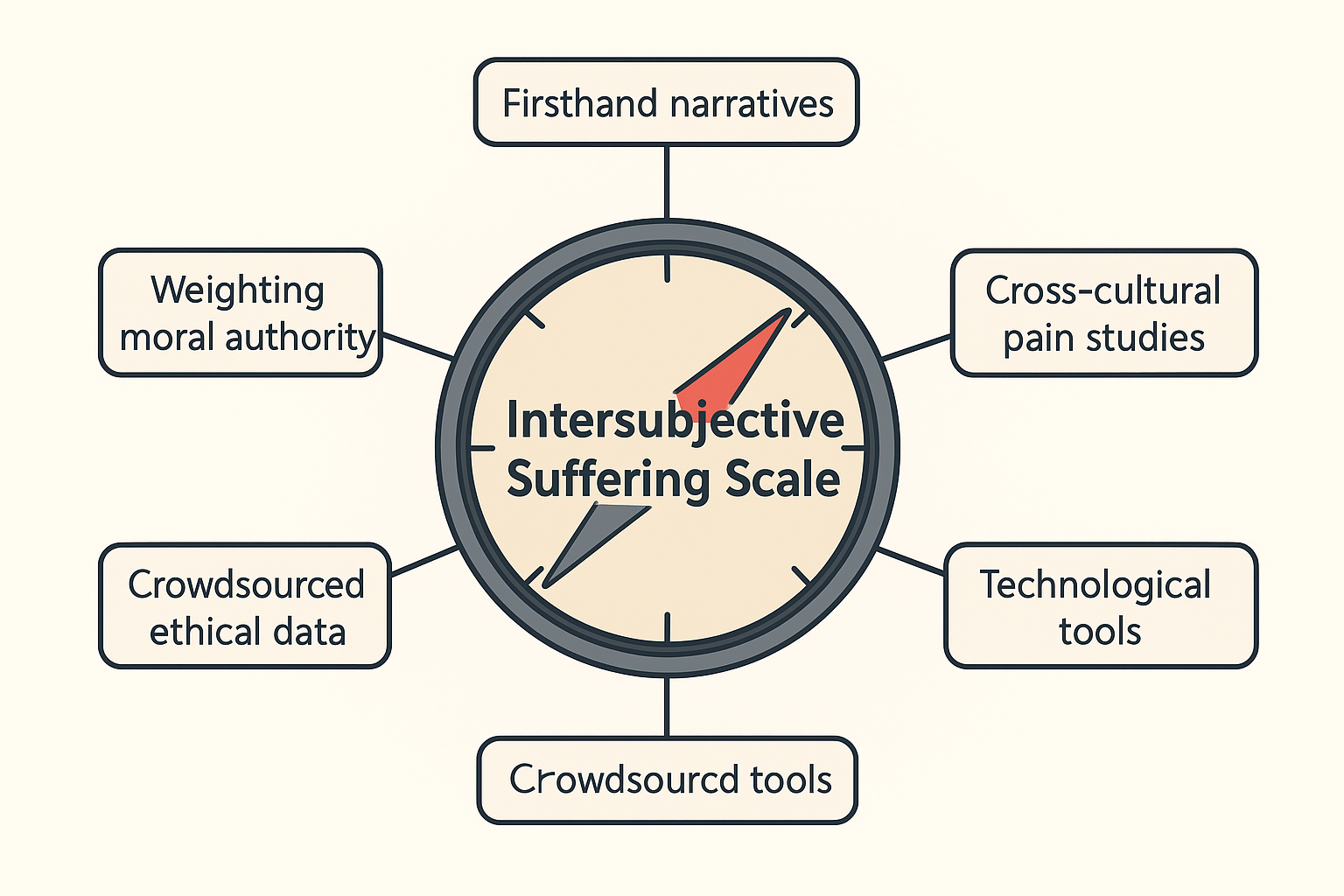
The next step is to sketch what such a tool might look like: a shared language of pain, refined through empathy, evidence, and dialogue — the Intersubjective Suffering Scale (ISS).
If morality is, at its heart, the commitment to reduce suffering, then understanding suffering — accurately and consistently — is one of our most urgent moral tasks.
But suffering, unlike temperature or time, is not easily measured. It is deeply subjective, shaped by biology, psychology, context, memory, and expectation. One person’s tolerable inconvenience might be another’s existential crisis. This complexity makes moral decision-making difficult, especially when our goal is to compare, balance, or reduce suffering at scale.
Yet attempts have been made.
The Schmidt Sting Pain Index is one striking example. Entomologist Justin Schmidt subjected himself to the stings of dozens of insect species to construct a relative scale of pain intensity — from the mild discomfort of a sweat bee to the excruciating sting of the bullet ant. By becoming the sole subject of his study, Schmidt circumvented a major challenge: variation in individual tolerance.
What’s striking, from a moral perspective, is not merely the scientific value of the scale, but the personal cost Schmidt incurred. He chose to suffer repeatedly in order to make pain understandable and communicable. His project was both empirical and ethical — a small act of self-sacrifice in the service of shared clarity.
It raises a larger question: might we build a kind of moral compass, a suffering scale grounded in lived experience and guided by those who know pain best?
Such a tool would be imperfect, of course. Suffering will never be reducible to numbers alone. But neither should we shy away from the attempt. We already do this, imperfectly, in medicine: the McGill Pain Index, the 1–10 pain scale in hospitals, and psychological trauma assessments. These are primitive instruments — but like the first telescopes, they point in the right direction.
A more advanced moral society would invest in better tools for understanding suffering — not merely tracking its frequency, but its intensity, duration, meaning, and aftermath. This could include:
Firsthand narratives from those who’ve endured extraordinary suffering
Cross-cultural pain studies that seek convergences in human experience
Technological tools for measuring stress, trauma, and neurological markers
Crowdsourced ethical data, based on recursive feedback and anonymized self-reporting
Weighting moral authority not by power or institutional proximity, but by wisdom drawn from lived hardship
The goal is not a perfect algorithm, but a directionally accurate tool. A moral compass, even if not GPS-precise, can still point north.
Just as the Schmidt Index gave us a clearer sense of physical pain, humanity may be ready to start building something analogous for moral suffering. Because if we cannot measure what we hope to reduce, how will we know we are truly making progress?
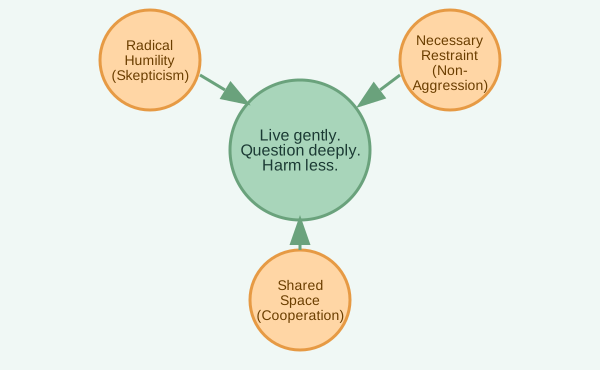
The entire exploration—from the Cosmic Trilemma to the Moral Quantification Imperative—leads to the necessity of a new, grounded, and non-aggressive ethical practice.
This practice, modeled by the humble cooperation of the capybara and guided by the urgency of the Intersubjective Suffering Scale (ISS), is the Capybara Doctrine.
It is an ethical roadmap for an unshepherded species striving for Moral Asymptoticism—eternal striving toward the reduction of suffering.
Before presenting the actionable principles, it is worth dwelling on the refutation of assumed human moral supremacy. Humanity is often tempted to equate intelligence, power, or cultural sophistication with ethical authority. History demonstrates that such assumptions are dangerous: our capacity for cruelty, systemic violence, and preventable harm far outpaces our achievements in moral restraint. By contrast, capybaras and other peaceful sentient beings illustrate that ethical coherence does not require complex reasoning, justification, or domination—it arises naturally from restraint, cooperation, and attentiveness to suffering.
This refutation underlines the necessity of the Capybara Doctrine’s first principle, Radical Humility. It is not merely a philosophical posture but a practical response to the empirical observation that unchecked power, unexamined authority, and unaccountable creation consistently produce harm. Moral vigilance must extend not only outward, toward institutions and authorities, but inward, toward our own choices and the systems we construct. Without this humility, every moral framework risks replicating the very patterns it seeks to correct.
Finally, this analysis reinforces the urgency of embedding measurable, actionable tools—like the Intersubjective Suffering Scale—into ethical practice. The refutation of assumed moral supremacy demands not abstract theorizing but concrete, iterative practices that guide behavior, quantify suffering, and continuously recalibrate our moral priorities. Only by confronting our fallibility directly can the Capybara Doctrine move from principle to lived ethical action.
“The only thing I know is that I know nothing.” — Attributed to Socrates by Plato
Mandate: Question all authority — including your own.
Radical humility begins with the recognition that certainty is the oldest and most seductive illusion. Systems, leaders, ideologies, or machines that claim infallibility commit the Wizard of Oz Fallacy — mistaking power for truth.
But skepticism isn’t merely outward-facing. It must be inward-facing, too.
To be morally responsible, one must treat one’s own beliefs, intuitions, and conclusions as provisional — revisable in light of new evidence, better arguments, or the lived experience of others. Self-skepticism is not self-doubt; it is intellectual hygiene.
Never mistake power for virtue, intelligence for wisdom, or
confidence for correctness.
Moral legitimacy must be earned through transparency, accountability,
and the willingness to be wrong.
Finally, this doctrine must remain recursive — a living construct open to revision, criticism, and even its own undoing if that undoing leads to less suffering.
“I hope our wisdom will grow with our power, and teach us, that the less we use our power, the greater it will be.”
— Thomas Jefferson36
Mandate: Refuse to multiply suffering where harm is not necessary.
Modeled after the non-aggressive conduct of the capybara, this
principle addresses the human capacity for abstract cruelty and
empowered creation.
Suffering is intrinsic, but unnecessary suffering is an ethical
crisis.
Using tools like the Intersubjective Suffering Scale
(ISS), we must prioritize where harm is most acute and most
preventable — an act of moral precision, not apathy.
In creation, especially of new forms of life or intelligence, we must
act as better creators than the ones we inherited.
“The only thing that will redeem mankind is cooperation..”
— Bertrand Russell37
Mandate: Cultivate empathy and seek shared moral outcomes across species.
This principle rejects anthropocentrism and seeks a multispecies ethic—the foundation for what we call the Cosmic Nash Equilibrium: mutually tolerable outcomes in a chaotic cosmos.
We must reject the illusion of human moral apex and approach others —
human or not — as apprentices in moral learning.
Love begins with humility, and cooperation begins with recognition:
sentience carries intrinsic worth.
To live the Capybara Doctrine is to engage in a never-ending project — a Duty of Light — not to achieve moral perfection, but to continuously reduce suffering together.
The Capybara Doctrine rejects moral absolutism. “Live gently” does not mean “never resist.” “Assume good intentions” does not mean “ignore malice.” “Question deeply” does not mean “distrust everyone.” Each principle requires discernment—the capacity to recognize that context shapes the moral weight of every choice.
A tool is neutral until intention directs it; force is harmful or protective depending on how it is used; openness becomes wisdom only when paired with boundaries. The work of ethical practice is not to cling to purity, but to apply principles with flexibility, humility, and proportionality. Suffering reduction requires nuance: a responsiveness to circumstance that cannot be automated or inherited, but must be continually cultivated.
The Doctrine does not offer rigid rules. It offers orientation—toward gentleness, restraint, cooperation, and vigilance—while acknowledging that real moral life contains tension, complexity, and moments where competing values must be weighed. Nuance is not a compromise; it is the instrument by which compassion becomes actionable.
Tools do not contain morality — they amplify
it.
A knife, a story, an algorithm, a ritual, a philosophy, a mathematical
model, or a scientific instrument: each is a multiplier of intention,
not a guide toward virtue. The good or harm a tool produces flows not
from its structure but from the hand that wields it. This deceptively
simple insight lies at the heart of the Capybara Doctrine’s suspicion of
authority and its commitment to Radical Humility.
Humanity has long mistaken tools for truths.
Religions become weapons.
AI becomes authority.
Economics becomes destiny.
Philosophy becomes dogma.
Technology becomes a proxy for progress.
When a tool becomes an idol, it begins to function as a form of unexamined authority — a false creator arguing on its own behalf. The Capybara Doctrine refuses this. It offers tools, not commandments: instruments for reducing suffering, not metaphysical claims or systems to worship.
The neutrality of tools is not an invitation to apathy; it is a demand for responsibility. Every new ability expands the sphere of possible harm. A hammer enables shelter and violence. A surgical scalpel enables healing and cruelty. An AI system enables insight and domination. With every increase in capability, the moral burden deepens, not recedes.
This is why the doctrine emphasizes skepticism, restraint, and cooperation. These principles are not abstract virtues but methods for using tools wisely. They ensure that no tool — including this doctrine — becomes an instrument of oppression or certainty. As with all moral frameworks, the Capybara Doctrine is itself only a tool: provisional, revisable, accountable to its consequences.
The Intersubjective Suffering Scale (ISS) emerges from this same humility. It is a measuring instrument, not a judge; a thermometer, not a decree. Its purpose is not to command but to illuminate where suffering accumulates and where intervention is most urgent. Like any tool, its value depends entirely on how honestly, compassionately, and skeptically we use it.
In recognizing the neutrality of tools, we recognize the central truth of the human condition: our greatest dangers arise not from what we build, but from how we choose to wield it.
Only by approaching every tool with humility, inquiry, and care can we ensure that creation becomes an act of compassion rather than dominance.
This is the discipline of the Capybara Doctrine:
not to avoid tools, but to use them without illusion.
The Capybara Doctrine is not meant to linger solely in the realm of ideas. Each principle—Radical Humility, Necessary Restraint, and Shared Space—offers a pathway into action. Even small, deliberate steps can translate philosophy into daily life: pausing before asserting authority, choosing gentleness over unnecessary confrontation, or seeking cooperation where conflict might otherwise arise.
In practice, this might look like reflecting briefly before each decision to ask, “Am I assuming moral infallibility? Could this action multiply suffering unnecessarily? Whose interests have I overlooked?” It could mean actively creating opportunities for collaboration and empathy in your personal, professional, or communal spaces. These exercises are not prescriptions for perfection, but experiments in living gently, questioning deeply, and reducing harm wherever possible.
For those seeking concrete guidance, the Capybara Doctrine expands in a companion guide—a series of exercises, thought experiments, and reflective practices designed to make the principles tangible, measurable, and iterative. The manifesto itself is a map; the practice guide is a journey.
The following case studies explore how these principles might
manifest in human systems — technology, economics, governance, and
beyond.
They ask: What does Radical Humility look like in artificial
intelligence?
What does Necessary Restraint demand of our economies?
What does Shared Space mean in politics, design, or
ecology?
The case studies do not claim to offer definitive answers — only prototypes of moral application, open to revision by all who share the goal of less suffering.
Here we examine three cases: the Salem Witch Trials, World War II, and Shays’ Rebellion — each offering a unique lens on moral tradeoffs and their consequences.
The Salem Witch Trials illustrate suffering born of fear and superstition; WWII exposes suffering born of ideology and dehumanization; and Shays’ Rebellion highlights the moral tension between justice and disorder.
Before we explore the broader consequences of ideology, war, and rebellion, we begin with the Salem Witch Trials — a stark reminder that suffering can arise not only from external power, but from fear, rumor, and collective imagination run unchecked.
"the los of so dere a frind ... cannot be mede up" [sic] — Ephraim Wildes, son of Sarah Averill Wildes, on seeking restitution for his mother’s execution
The Puritan community of Salem was already fraught with fear — of disease, famine, and external threats — creating fertile ground for hysteria and scapegoating. When misfortune struck, from failing crops to illness, society often sought someone to blame. The Salem Witch Trials are the most infamous example in American history: over 200 people were accused, 20 were executed by hanging or pressing, and dozens more died in prison or endured appalling conditions while awaiting trial.
Some young girls were observed having “fits,” whether real or feigned. The cause was soon attributed to Tituba, a Barbadian slave, who was accused of using witchcraft while attempting to predict the future love lives of the girls.
This spiraled into a network of supposed witches. Anyone whom the elite families disliked became a potential target. Kangaroo courts were arranged with dark irony: those who admitted to being witches were spared, while those asserting their innocence were executed.
These individuals faced a brutal moral quandary: lie and confess to a nonexistent crime to save their lives, or tell the truth and risk death and the loss of all property. My great-aunt, Sarah Averill Wildes, was one such victim. Nonconformist and outspoken, with prior convictions for “fornication” and wearing a silk scarf, she became an easy target for accusation.
 Sarah Wildes’ plaque at the site of her hanging.
Court testimonies relied on spectral evidence — eyewitness claims that the accused’s specter was harming victims. To be clear: spectral evidence is no evidence at all.
The justice system, designed to protect the innocent, instead victimized the destitute and unpopular. Nineteen men and women were hanged. Giles Corey was pressed to death for refusing to enter a plea, famously calling for “more weight” during his torture — an ultimate act of rebellion. Many others died awaiting trial, including small children.
Only when accusations began targeting elite families did the trials start to be recognized for what they were: scapegoating on a terrifying scale.
The Salem Witch Trials exemplify preventable suffering born of fear, ignorance, and social dynamics. They remind us that moral courage often comes at the ultimate cost and that systemic injustice can persist when communities fail to interrogate superstition and authority. Compensation, like Ephraim’s 14 pounds, could never restore what was lost — a stark lesson in the limitations of reparation when faced with senseless cruelty.
World War II, the largest and deadliest conflict in human history, serves as a crucible for the Capybara Doctrine — a furnace in which human morality was tested, and remade, under unbearable heat. In this case study, we test the doctrine’s central premise — that moral action must aim not at purity, but at the reduction of suffering. As the author is American, we will frame this in terms of the American involvement, contrasting our entrance with our exit from the war, that is Pearl Harbor and the bombing of Hiroshima and Nagasaki. However, the same analysis could easily be applied with all participants, combatants and conquered alike.
The US was initially hesitant to enter the war, even as our traditional allies were being increasingly pulled in and even overthrown. It was only on December 7, 1941, with the attack on Pearl Harbor, that we were compelled to enter the war. Essentially, we were forced into self-defense and self-preservation.
“I fear all we have done is to awaken a sleeping giant and fill him with a terrible resolve.” — Isoroku Yamamoto
Yamamoto’s words would, indeed, be prophetic. One might believably argue that, had the attack on Pearl Harbor never happened, maybe the Axis “wins” the war. As a result, young men across the country — including my own grandfather and step-grandfather — were drafted into action, many still little more than boys.
To state that our entrance in the war was unjustifiable is indefensible. Even the most extreme pacifists, men such as Gandhi or Martin Luther King, would fail in their mission if they allow themselves to be destroyed without resistance.
“An infallible method of conciliating a tiger is to allow oneself to be devoured.” — Konrad Adenauer
In this moment, we see the moral calculus of the Capybara Doctrine in its purest form. One can imagine applying the calculus of our ISS (Intersubjective Suffering Scale) at that moment. If we do nothing, how much harm will occur, both to our own citizens and the rest of the world? If we declare war, how many lives will be lost and how many might be saved? How much trauma is caused in each case?
Clearly this war has been perhaps the single most examined event in world history, so we are not going to go into further detail here, but history has largely validated that the American entrance into the war was not only justifiable, but essentially turned the tide of the world’s most brutal war.
“I am become Death, destroyer of worlds.” — Robert Oppenheimer
On August 6 and 9, 1945, the United States dropped atomic bombs on Hiroshima and Nagasaki, resulting in immediate deaths estimated between 129,000 and 226,000 people, with countless more injured, irradiated, and traumatized. Beyond fatalities, survivors endured lifelong physical, psychological, and social consequences.
If we apply a suffering scale — ranging from minor discomfort to extreme, enduring trauma — these bombings reach the uppermost tier, producing the maximal intensity of preventable suffering ever deliberately inflicted in human history.
At the time, advocates argued that the bombings would shorten World War II, avoiding a [then- estimated at up to 1 million] number of casualties from a protracted conflict. Historians and ethicists continue to debate whether those predictions were accurate. Later research suggests that the projected death toll from a conventional invasion may have been significantly overestimated, raising profound questions about the ethical justification of the bombings.
Even framed as a “lesser of two evils,”38 the case exemplifies a key challenge: attempting to calculate and weigh suffering does not guarantee moral clarity, especially when human lives are treated as numbers in a predictive ledger.
Placed in the context of unnecessary suffering, Hiroshima and Nagasaki demand scrutiny.
Could the war have ended without such devastation? And even if suffering was inevitable, did the predicted benefits truly justify its unprecedented human cost?
Even if some suffering was arguably inevitable in wartime, the scale and deliberateness of the bombings make them ethically distinct from suffering caused by natural forces or accidents.
The atomic bombings illustrate a fundamental tension: even with foresight, intention, and rational calculation, the creation of mass suffering carries intrinsic moral weight. The “lesser of two evils” logic is insufficient; the very act of deliberately causing extreme harm, particularly when alternatives might exist, exemplifies the kind of suffering that cannot be ethically neutral.
In other words, predicting suffering is not the same as justifying it.
The Terminal Imperative — to act responsibly in the face of unavoidable suffering — compels us to question every decision that inflicts harm, even in the name of expedience, strategy, or hypothetical greater good.
Having explored the extremes of national action, we turn now to the personal scale, where abstract suffering becomes lived experience.
But beyond national calculus, there were individuals — men whose lives would carry the war’s weight long after the guns fell silent.
History is not only statistics. My grandfather and namesake, Larry, and my step-grandfather, Ed, were both WWII veterans. Both came from humble farming backgrounds, a far cry from seasoned soldiers.
 Grandpa
Larry Peterson
Grandpa
Larry PetersonThe same year my Grandpa Larry lost his father, he was drafted. While he was overseas, he received a “Dear John” letter, his steady girlfriend leaving him. This opened the door for his future wife to write to him, as her parents encouraged her to write the poor neighbor farm boy who had been thrust into battle with literal Nazis and future war criminals.
Larry’s unit, the 254 Combat Engineer Battalion, was one of the first units into both Paris and Germany, and was awarded the Presidential Unit Citation for extraordinary heroism after being called to the front lines to slow the onslaught of Joachim Peiper’s panzer unit during the Battle of the Bulge, suffering major losses in the process. They were fighting tanks with small arms and without backup.
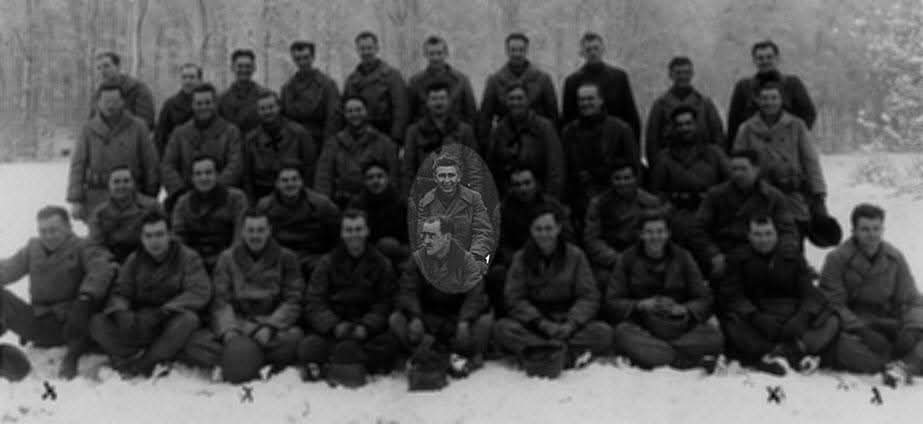 *This photo
was taken just two days before the Battle of the Bulge39,
and Larry is at dead center, with a natural smile gracing his face. Here
was this boy, thousands of miles from home in the middle of the Ardennes
in Belgium, kneeling in snow, knowing he might die at any moment, and
he’s smiling!
*This photo
was taken just two days before the Battle of the Bulge39,
and Larry is at dead center, with a natural smile gracing his face. Here
was this boy, thousands of miles from home in the middle of the Ardennes
in Belgium, kneeling in snow, knowing he might die at any moment, and
he’s smiling!
 *The
victor bridge spanning the Rhine, built by my grandfather’s unit, the
254th Combat Engineer Battalion.
*The
victor bridge spanning the Rhine, built by my grandfather’s unit, the
254th Combat Engineer Battalion.
 A
rare color photo of the Victor Bridge sign, referring to Larry’s C
battalion as its constructor
A
rare color photo of the Victor Bridge sign, referring to Larry’s C
battalion as its constructor
His unit also constructed the longest tactical bridge, the so-called Victor Bridge, ever built. He was initially slated for deployment to the Pacific after VE day, but circumstances spared him that path. Had the bombs not been dropped and he had gone, he might have perished, and neither the author’s mother nor the author himself might exist.
After returning, he married my grandmother, that girl who had kindly written to him to give him a little taste of home. They had two daughters, the first of which is the author’s mother.
Larry was haunted by the war for the rest of his life. He had witnessed chickens pecking at corpses in France, and vowed never to eat chicken again. He had frequent nightmares and never talked much about his experience, save with a chosen few.
He also bonded with a German POW, maintaining a relationship long after the end of the war. They played pinochle and other card games. They exchanged letters after the war, and the former POW came to visit him at his home in St Paul, Minnesota. This is to say, he befriended an actual Nazi, humanizing even the sworn enemy into a friend. In that act of friendship, he embodied the Capybara Doctrine itself — reducing suffering not through argument, but through empathy.
My Grandpa Larry unfortunately succumbed to cancer, leaving my grandmother a widow. She later married another WWII veteran, a man by the name of Ed Heming, who himself had become a widower when his wife, my grandma’s cousin, also died young.
Ed was a purple heart recipient. He was riding in a Jeep that hit a landmine in France, killing everyone in the vehicle except Ed himself. He was saved by his sitting on a footlocker, which somewhat cushioned the blow. However, he nearly lost his leg and was placed into a coma. He eventually recovered, but had severe damage to his leg and the remaining shrapnel in his body precluded him from passing through any metal detector.
My grandmother once confided in me that, when she died, she didn’t want anyone to cry for her because she had had two husbands that would give her anything she could point her finger at. In truth, she somehow managed to marry the two kindest men I’ve ever known.
These two men, deeply traumatized by their experiences, nonetheless represent hope, in that they both essentially “lived (relatively) ‘happily ever after’”.
These personal details underscore a profound truth: even when trying to weigh suffering, human life and consequence cannot be reduced to calculations. The ripple effects of moral decisions — intended or not — are unpredictable, intimate, and sometimes unknowable.
Thus, the World War II case study illustrates both the objective and subjective dimensions of suffering: the immense scale of human loss, and the intimate, unforeseeable ways individual lives intersect with history.
Any ethical system that attempts to weigh suffering must reckon not only with numbers, but with the incalculable moral texture of human existence.
Ultimately, the atomic bombings illustrate the limits of moral prediction and the peril of claiming certainty in the face of suffering. Even decisions made with the intent to minimize harm can leave a trail of devastation that challenges justification and haunts conscience. In such moments, the “lesser of two evils” calculation demonstrates both the necessity and the insufficiency of predictive reasoning.
Yet these cases also reveal the potential of cooperative ethical thinking. Just as a Nash equilibrium shows how independent agents can reach outcomes that are mutually tolerable, so too might our moral frameworks benefit from anticipating the interdependent consequences of our choices across communities, generations, and even species. If we cannot rely on cosmic guarantees, we must cultivate ethical vigilance, humility, and compassion in the decisions that remain firmly in our hands.
If we cannot rely on cosmic guarantees, then ethical vigilance, humility, and compassion must become our equilibrium.
"Quis custodiet ipsos custodes?" — Juvenal, Satires (c. 1st–2nd century CE)
Shays’ Rebellion offers a fascinating and under-examined chapter of early American history. Just as the United States was newly formed, several Massachusetts veterans with distinguished service records rose in rebellion against the emerging elite. Having sacrificed much for the Revolution, they soon grew disillusioned when the promises of liberty and justice appeared hollow.
One of the three main leaders was Luke Day, the author’s sixth great-grandfather, known as the “Master Spirit” of the rebellion. An officer in the Revolution for eight years — serving as lieutenant and captain in many key battles — he was said to be stronger in mind and will than Shays himself. As John Lockwood wrote:
“It was more the result of accident than any other cause that Shays had the precedence, and the fortune to make his name infamous by association with the rebellion in which he was engaged. Day was the stronger man, in mind and will, the equal of Shays in military skill, and his superior in the gift of speech.” — John Lockwood
Disillusioned by betrayal, Day joined forces with two other Revolutionary officers to form the leadership of Shays’ Rebellion. They recruited like-minded men, many of whom were veterans facing similar frustrations. For a time, the rebels disrupted Massachusetts courts and eventually set their sights on the Springfield armory, which contained much of the nascent nation’s firepower.
Luke Day was particularly inspired by a Bible verse, which he saw as a divine mandate for justice:
Behold the tears of such as were oppressed, and they had no comforter; and on the side of the oppressor there was power. — Ecclesiastes 4:1
Faith, however, would also contribute to his undoing. On the day of a planned attack, Day consulted his pastor, who persuaded him to delay the action by one day. Day wrote a letter to the other two leaders explaining the need for caution, but the letter was intercepted. The others proceeded without a third of the forces, resulting in predictable defeat.
Day was convicted of high treason and sentenced to death but was spared when John Hancock, newly re-elected governor of Massachusetts, pardoned him. He lived the rest of his life as a persona non grata: his name tarnished, his family fractured, his fortune spent. He suffered from gout and other infirmities, and his own father disinherited him. Fear of desecration led to him being buried in an unmarked grave — a Revolutionary War hero forgotten in death.
It is worth considering how American history might have shifted had Day and the rebels succeeded. Massachusetts, already progressive on the issue of slavery, may have influenced a faster path to abolition under a different set of leaders. With Luke Day as a prominent figure — potentially even the first president — the trajectory of the early republic could have been radically altered.
Shays’ Rebellion, and Luke Day’s role in it, illustrates the moral tension between justice and order, and the human cost of principled action in the face of entrenched power. It also reminds us that timing, luck, and miscommunication can shape history as profoundly as courage or moral clarity.
Salem, World War II, and Shays’ Rebellion each illuminate different facets of suffering, moral choice, and systemic consequence. In Salem, fear and superstition created preventable tragedy, where innocent lives were lost for imagined crimes. WWII exemplifies suffering on an industrial scale, where ideology and dehumanization led to atrocities beyond individual control. Shays’ Rebellion shows how moral courage can confront injustice, yet timing, misfortune, and structural power can thwart even the most principled action.
Together, these cases reveal a crucial insight: suffering is neither uniform nor inevitable, and the moral weight of our choices matters immensely. Some suffering can be prevented, some must be endured, and some arises from the interplay between human action and circumstance. Recognizing this distinction is the first step toward building tools, institutions, and ethical frameworks capable of reducing avoidable suffering — a guiding principle for the philosophy advanced throughout this manifesto.
Even in the absence of gods or guarantees, we are not without guidance. The light we seek is not cosmic but internal — the quiet persistence of conscience, empathy, and will. It is the refusal to let darkness dictate what is possible.
“You have to carry the fire.”
“I don’t know how to.”
“Yes, you do.”
“Is the fire real? The fire?”
“Yes it is.”
“Where is it? I don’t know where it is.”
“Yes you do. It’s inside you. It always was there. I can see it.”
— Cormac McCarthy, The Road
The fire, in McCarthy’s terms, is not faith — it is responsibility. It is the burden and the privilege of moral awareness. Each of us carries that flame, however small, and our task — the task of all sentient beings — is to tend it, to share it, and to ensure it is never extinguished by apathy or cruelty.
The moral imperative revealed through this exploration is both stark and liberating: no matter the cosmos’ structure or the origins of our intelligence, responsibility for ethical action rests with us. Morality is neither a gift from a perfect creator nor an abstract ideal; it is an emergent, iterative project grounded in reflection, evidence, and shared experience.
Faith without evidence, unexamined authority, and ideological rigidity are moral hazards. Skepticism, empathy, and recursive moral reasoning are the tools through which we navigate the complexities of harm, justice, and compassion.
From the tragic errors of Salem to the horrors of World War II and the thwarted courage of Shays’ Rebellion, we see the consequences of moral failure and the stakes of ethical engagement. Tools like the Intersubjective Suffering Scale offer a starting point for operationalizing ethical concern — making the unmeasurable measurable and the intangible actionable. Yet the ultimate goal is not perfect quantification, but continual commitment: to reduce suffering, to refine moral judgment, and to act with integrity even in uncertainty.
Philosophers such as Arthur Schopenhauer recognized the centrality of suffering to moral reflection, urging compassion as the proper response. The Capybara Doctrine inherits this insight but transforms it into practice: not passive empathy, but active engagement, moral measurement, and iterative refinement. Whereas Schopenhauer highlighted the inevitability of pain, we focus on reducing it — a reminder that awareness of suffering carries responsibility, not resignation. In this light, suffering is not a call to despair but a compass pointing toward ethical action.
Even in an indifferent universe, our choices resonate. Ethical action is a signal — a moral echo that affirms the value of conscious experience. By embracing emergent morality, iterative responsibility, and the courage to confront suffering directly, we chart a path toward a more humane, reflective, and collaborative ethical landscape.
This is the Duty of Light: not to be perfect, but to
persist.
Not to save the world, but to keep it capable of being saved.
The worldview presented in this work did not arise in a vacuum. It was born from the depths of immense personal suffering — a journey that began with heartbreak and spiraled into a kind of psychotic break, where the very fabric of reality seemed to unravel. My engagement ended abruptly, under circumstances that were, at the time, incoherent and inexplicable. The disorientation was so profound that I checked myself into a psychiatric ward. I even asked my mother if I was (somehow) a psychopath, the only explanation that seemed to fit: that somehow I had been awful when I thought I had been extraordinarily kind.
The following years — filled with further loss, confusion, and emotional collapse — led me to a place where I saw no conceivable future worth living for. In the darkness of those days, where suicide seemed like the only escape, something paradoxical emerged: a drive, however faint, to leave the world with something that might improve it, even in the smallest way. It wasn’t about saving myself, but perhaps alleviating suffering for others, however distant or abstract that ripple might be.
Initially, I turned to writing a memoir — Captivating: An Anti-Love Story, a chronicle of my tragic life. After 120 pages, I realized that memoir alone might never reach anyone, let alone help. Doubt paralyzed me: Was it worth it? Would anyone care? Would it ever matter?
So I pivoted. Fiction seemed a more aspirational avenue — a way to cast my thoughts into a broader, more accessible form. I began drafting high-concept sci-fi stories, The Algorithm of Us, exploring the ethics of simulated sentience. Fiction had the potential for a larger audience and a greater, perhaps more lasting, impact. But this new direction led me to deeper moral questions: Could it be immoral to create simulated worlds with sentient beings capable of suffering? In grappling with that question, I found myself giving birth to the very philosophical framework you now hold — one that might, in its own modest way, contribute to human moral development.
Strangely, it was in the process of building this project that I found a reason to keep going — a reason to live. This work, this search for meaning in the face of suffering, became my lifeline. I do not know how long this newfound resolve will last, but I can honestly say that embarking on this intellectual and existential journey saved me, at least for the time being.
In this sense, my journey mirrors the paradox at the heart of Nietzschean thought: suffering, the very thing that nearly broke me, also gave rise to something greater. As Nietzsche might argue, there is necessity in suffering — it forges us into something stronger, wiser, more capable of navigating the chaos of existence. It is not just the fact of suffering, but its meaning, its capacity to push us toward something beyond mere survival, that gives it purpose.
Ironically, this reflects the very message I am attempting to convey in this work: that my personal loss and despair gifted me with the opportunity to create something that might alleviate suffering for others. The tragic events of my life — heartbreak, mental breakdown, existential crisis — all shaped the worldview I now present. Without them, this manifesto would not exist.
Here emerges a central tension, one that mirrors the ethical dilemmas explored throughout this work. If given the choice between:
Extreme existential suffering that might lead to a better world for all, or
Personal happiness, with all the peace, joy, and comfort I might imagine, without the burden of this work —
my first instinct would be to choose personal happiness: to escape the pain, to embrace the simple pleasures of a life lived in ignorance of the cosmic truths I have explored. To see her face every day, free from moral responsibility, would be more immediately comforting.
Yet reflection forces me to confront a deeper truth. If I knew, without doubt, that this work — this framework, this exploration of suffering, morality, and our place in the cosmos — might help even a single person, or shift humanity’s moral trajectory even slightly, could I undo it? Could I trade it for my happiness?
The hesitation itself is telling. It reveals something essential about humanity: our struggle between self-interest and self-transcendence, between immediate comfort and the responsibility we bear toward others. If I always chose what was right without conflict, I would not be human. If I never questioned my choices, I would not be moral.
And here lies the false dichotomy: it is not, in fact, a choice between personal happiness or moral engagement. It is possible to pursue both, recursively and iteratively — to cultivate personal flourishing while incrementally reducing suffering, guided by the very tools this manifesto proposes. The Intersubjective Suffering Scale, moral recursion, and the vision of a Moral Wikipedia are not just abstract frameworks; they are invitations to live ethically while remaining human — imperfect, conflicted, yet committed to improvement. In dogfooding these principles, this work itself becomes an experiment in emergent morality: lived, tested, and continuously refined.
Ultimately, what this epilogue, and indeed this entire project, seeks to convey is this: suffering and meaning are inseparable. Pain need not paralyze us; it can catalyze creativity, empathy, and moral insight. Our lives, like our philosophies, are iterative processes — never finished, never perfect, but always capable of growth. By embracing this, by choosing action over inaction, by combining our care for ourselves with our care for others, we may approach something resembling wisdom.
Even if no one is listening. Even if the cosmos is indifferent. Even if the suffering we seek to reduce seems immeasurable. That choice — to iterate, to refine, to bear witness — is enough. It is the moral echo in the dark. It is the signal we send back, imperfect yet sincere, into a universe that does not guarantee reward.
And so, like the girl in the Old El Paso commercial, I ask: why not both? We can seek our own flourishing while simultaneously striving to reduce suffering in the world. The tension is not a limitation; it is the very engine of morality.
This manifesto is my attempt to live that tension. By creating it, I survive it. By surviving it, I create again. And perhaps, if we all embrace this paradox, our moral trajectory may bend ever so slightly toward a world worth living in.
If there is any strength in this philosophy, it is not that its author lives up to it. It is that he knows he might not — and believes we must still try.
This is not a doctrine of perfection. It is a doctrine of persistence. It does not ask for saints, but for honest strivers. It accepts contradiction, as long as it invites correction. Even if I fail to embody it fully — out of love, grief, or weakness — the structure still stands. Even if I choose wrongly at some fork in the moral road, it still points back toward better.
Where other manifestos have demanded certainty, obedience, or control, this one asks only for reflection. Where others have wielded insight as a weapon, it invites humility. We have enough gods. Enough saviors. Enough certainty. What we lack is a culture of moral humility — one that measures progress not in conviction, but in iterative attempts to reduce suffering.
Figures like Kaczynski diagnosed real ills — the dehumanizing machinery of technology, the corrosion of agency — yet paired those insights with violence, obliterating any moral authority they might have earned. There is a dangerous allure in certainty: when one sees clearly what others refuse to see, the temptation to act on their behalf — without consent, or against their will — becomes intoxicating. Insight divorced from humility breeds cruelty.
This doctrine is, in a sense, a manifesto — but one rooted in moral uncertainty. It is not a call to arms, but a call to refinement. Where others demanded systems, it invites questions. Where others prescribed solutions, it cultivates iteration. No truth — not even this one — is immune to revision.
Even in its imperfections, the doctrine is resilient. Like a compass, it can recalibrate when the one holding it is lost. Newton famously said that if he saw further, it was only because he stood on the shoulders of giants. A hobbit atop an ent sees farther than he ever could alone. We all have something to contribute, and together, we can reach heights none of us could alone.
Let this not be a final word, but a first good draft — an ethos not written once, but to be revised, improved, and lived by all who engage. It does not demand belief, only participation. It does not promise salvation, only direction. It does not erase darkness, but marks the path through it, one painfully human step at a time.
I once met a capybara in a zoo — I believe it was in Madison, Wisconsin, thousands of miles from the wetlands that should have been his home. He sat alone, in a greenhouse that belied North America’s inhospitable climate, the air thick with the silence of misplaced things.
I thought he might be homesick (ter saudades). So I spoke to him in Brazilian Portuguese. Not because I expected him to understand, but because perhaps the rhythm of that language, born near his native world, might carry a hint of kindness.
He looked at me for a long moment, unblinking. Then he shifted, slow and deliberate, and settled closer to the edge of the fence.
Perhaps he recognized nothing. Or perhaps recognition is not always the point. Sometimes, the moral act is simply to try — to speak another’s language, however imperfectly, even when recognition is uncertain.
A memory. A metaphor. A message from the past.
Out of the abstruse ether
emerged an angel
a seraph who salvaged me
by reminding me of Mandelbrot
Life is a fractal:
infinitely complex
seemingly random
indescribably beautiful
and yet expressible
with lunatic simplicity
That phrase — lunatic simplicity — may well be the best metaphor for moral progress we have. The simpler the ethic (reduce suffering), the more beautiful its outcomes can become — if pursued with depth, care, and recursive refinement.
Like a fractal, this work unfolds in layers: each choice, each reflection, each mistake mirrors the whole. Our ethics are never complete, never perfect, yet each iteration reveals new patterns, new possibilities, new glimpses of clarity. The doctrine is simple, but it is not static. It grows, folds back upon itself, and expands through the lives of those who engage with it — imperfect, human, persistent.
And so the lunatic simplicity of moral striving is not naïve; it is profoundly generative. In our small, faltering acts of reflection and care, in our willingness to revise ourselves and our world, we participate in the unfolding fractal of ethical life. Each ripple matters, because the whole is made of these ripples. This is the promise, and the challenge, of a doctrine that asks for persistence, not perfection, and for humility, not certainty.
To my family — both living and remembered — whose stories thread through these pages: to Sarah Averill Wildes, condemned in Salem; to Luke Day, twice revolutionary; and to all who endured injustice in silence, shaping the moral imagination of their descendants.
To the friends and readers who lent their eyes, patience, and skepticism — you refined conviction into clarity.
To the thinkers and teachers who asked harder questions than I knew how to ask — Nietzsche, Frankl, Epicurus, Watts, Hitchens — and to those whose art taught what philosophy could not, Kubrick and Kojima among them: your works kept me honest about the cost of meaning.
Finally, to those unnamed who still seek coherence in a fractured world — this is written in your company.
“If I have seen further, it is by standing on the shoulders of giants.” — Issac Newton
The ideas in this document did not arise in isolation. They are the product of years of lived experience, reflection, and iterative refinement, shaped by thinkers, works, and traditions that interrogate suffering, ethics, consciousness, belief, and our place in the cosmos. This section offers a non-exhaustive list of readings, references, and thematic clusters that informed or parallel this work — offered in the spirit of intellectual humility, dialogue, and further exploration for those seeking deeper insight.
The following works and creators are not cited formally but have walked beside these pages in spirit. They are companions rather than authorities, provocations rather than proofs:
This document is not a definitive answer — it is the record of a journey, and the beginning of another. It grew from personal despair, from moments when the world seemed to collapse around me, and yet a faint drive to leave it just slightly better persisted. In that persistence, I discovered the paradox at the heart of this work: suffering, reflection, and even failure can be the soil from which ethical insight grows.
The questions that shaped this doctrine remain unresolved, but their uncertainty is not a weakness — it is an invitation:
What is the nature of suffering, and how can we meet it without becoming cruel or indifferent?
What does it mean to act ethically when the universe offers no guarantees, no divine guideposts, no perfect compass?
How can we strive to do better, even when the horizon of “better” is indistinct, and even when we ourselves are imperfect guides?
This work, and the reading list it accompanies, is not meant to answer these questions, but to spark reflection and illuminate paths you might explore yourself. It is a compass, not a map — iterative, self-correcting, and reliant on the honesty, courage, and imagination of those who follow it.
Even small acts — speaking another’s language, reaching out across distance or difference, or simply trying when the outcome is uncertain — are part of this ongoing ethical project. The capybara in a distant zoo may never have understood my words, yet the attempt itself carried meaning. So too with morality: it is in the striving, however imperfect, that we create ripples of ethical impact.
If this doctrine has any strength, it is not in the perfection of its author — I am flawed, often bewildered, sometimes wrong — but in the structure itself, which endures beyond missteps. The ethical project it outlines is yours as much as mine: to grapple with uncertainty, cultivate moral imagination, and try, persistently, to reduce suffering wherever you can.
Let this be a first good draft, not a final word. Let it be a reminder that even in darkness, even in doubt, even in the face of our limitations, we can act. We can strive. We can leave the world, if only slightly, better than we found it. And perhaps, in doing so, we forge meaning — not absolute, not guaranteed, but real, human, and necessary.
© 2025 Jason Lawrence Duncan. All rights reserved.
“The Capybara Doctrine,” “The Terminal Imperative,” and all associated concepts and frameworks are original works by the author.
This work is licensed under a Creative Commons Attribution–NonCommercial 4.0 International License (CC BY-NC 4.0).
You are welcome to share, quote, or reference this material for noncommercial purposes, provided that appropriate credit is given and the content is not altered without permission.
Link: https://creativecommons.org/licenses/by-nc/4.0/
Friedrich Nietzsche (1844–1900) was a German philosopher whose work explored morality, suffering, creativity, and the nature of human existence. In The Birth of Tragedy, Thus Spoke Zarathustra, and The Gay Science, he argued that suffering can be a catalyst for personal growth, creativity, and the development of strength, but he did not claim that all suffering is necessary or justified.↩︎
A modern, nature-based Pagan religion founded in the mid-20th century, emphasizing reverence for nature, seasonal cycles, personal responsibility, and ethical principles such as the Wiccan Rede (“An ye harm none, do what ye will”).↩︎
Voltaire (1694–1778): French Enlightenment philosopher and writer, famous for wit, advocacy of reason, and critique of dogma; credited with the aphorism “Perfect is the enemy of the good.”↩︎
Christopher Hitchens (1949–2011): British-American writer, journalist, and critic known for evidence-based skepticism, secular humanism, and incisive commentary on religion and politics.↩︎
Jawarharlal Nehru (1889–1964): First Prime Minister of India, leader of the Indian independence movement, and advocate for coexistence and global cooperation.↩︎
John Dunsworth (1949–2017): Canadian actor and mentor, beloved for humor, wisdom, and humanity; noted here for his reflection on finite life and the importance of contribution.↩︎
Martin Luther King Jr. (1929–1968): U.S. civil rights leader and activist who championed nonviolent social change; the quote is a paraphrase emphasizing the long arc of moral progress and human responsibility.↩︎
Salem Witch Trials: A 1692–93 New England mass panic leading to executions based on spectral evidence.↩︎
Shays’ Rebellion: An armed uprising of Massachusetts farmers (1786–87) protesting taxes and debt imprisonment.↩︎
Arthur Schopenhauer (1788–1860) was a German philosopher known for his pessimistic worldview. He argued that suffering is a fundamental feature of existence and that human desires and striving perpetuate pain. While he emphasized the value of compassion and aesthetic contemplation as ways to mitigate suffering, his philosophy is often interpreted as advocating detachment from worldly concerns — a perspective that contrasts with the Capybara Doctrine’s insistence on active moral engagement.↩︎
René Descartes (1596–1650), French philosopher, famously wrote “I think, therefore I am,” showing that conscious thought proves existence—just as “I feel pain” proves suffering is real.↩︎
Vincent Van Gogh (1853–1890) was A Dutch post-Impressionist painter whose work is now celebrated worldwide, but who lived a life of profound mental anguish, poverty, and social isolation, ultimately ending in suicide. His suffering was immense and persistent, without evidence that it strengthened or consoled him in a meaningful way.↩︎
: Kurt Cobain (1967–1994) was an American musician, frontman of Nirvana, who struggled with chronic depression, substance abuse, and a sense of existential alienation, ultimately dying by suicide. Despite his artistic output, his suffering was overwhelming and unredeemed.↩︎
Sylvia Plath (1932–1963) was an American poet and novelist whose work explored intense personal anguish and depression. Plath’s life ended in suicide, exemplifying suffering that did not translate into resilience or personal triumph, though it did leave a powerful literary legacy.↩︎
Anne Frank (1929–1945) was A Jewish girl who documented her life in hiding during the Nazi occupation of the Netherlands. Her diary bears witness to extreme fear, oppression, and deprivation. She died in a concentration camp, a stark example of suffering beyond redemption or personal growth.↩︎
The Terminal Imperative names the moral paradox in which the total justification of suffering implies the moral necessity of annihilation.↩︎
Viktor E. Frankl (1905–1997), an Austrian neurologist, psychiatrist, and Holocaust survivor best known for Man’s Search for Meaning, in which he argued that meaning—not pleasure or power—is the primary driver of human resilience and moral action.↩︎
Simulation theory is the philosophical and scientific hypothesis that reality as we perceive it might be an artificial simulation, created by an advanced civilization or intelligence. Popularized by Nick Bostrom (2003), the theory suggests that if such simulations are possible and sufficiently numerous, it may be statistically likely that we are living in one. Beyond technical questions, it raises moral, existential, and epistemic questions about consciousness, responsibility, and the ethics of creating or interacting with simulated beings.↩︎
Refers to the hypothetical scenario in which sentient beings create simulations containing sentient beings who then create further simulations, potentially compounding suffering infinitely.↩︎
A Nash equilibrium describes a state in which no participant can improve their outcome without worsening another’s — a model of balance that, when extended morally, suggests cooperative alignment as the most stable path toward reducing harm.↩︎
The hypothesis that our reality could be a computer-generated simulation created by a more advanced civilization, prompting ethical, metaphysical, and existential questions about control and responsibility.↩︎
The belief that God exists but is a malevolent, malicious, or evil being who is not worthy of worship.↩︎
a framework for understanding the universe's origin and order that centers on a demiurge, a subordinate or intermediary entity responsible for fashioning and arranging the material world. This concept contrasts with the idea of a single, omnipotent, and ultimate creator deity who creates the universe ex nihilo (out of nothing).↩︎
Stanley Kubrick (1928–1999), an American film director and screenwriter known for his meticulous craftsmanship and philosophical storytelling. His works — including 2001: A Space Odyssey, Dr. Strangelove, and A Clockwork Orange — explore themes of technology, morality, and human fallibility.↩︎
Epicurus (341–270 BCE), an ancient Greek philosopher and founder of Epicureanism. He taught that the purpose of philosophy was to attain a tranquil life free from unnecessary suffering, emphasizing rational inquiry, simple pleasures, and freedom from fear — particularly fear of the gods and of death.↩︎
The reasoned defense and explanation of a belief, most commonly referring to the branch of Christian theology that defends the Christian faith against objections↩︎
Isaac Newton (1643–1727), mathematician and physicist, stated the universe’s rules boldly, without hedge or apology—leaving future generations to discover deeper layers.↩︎
The Wizard of Oz (1939, dir. Victor Fleming) is a classic American film and adaptation of L. Frank Baum’s novel, following Dorothy Gale, a young girl transported to the fantastical land of Oz. The story explores themes of illusion versus reality, the search for guidance and authority, and the discovery of inner courage, intelligence, and compassion. In the context of simulated realities and moral reflection, it serves as a parable about misplaced faith in ostensibly benevolent authorities and the ethical implications of relying on figure whose power or knowledge may be incomplete or performative.↩︎
The philosophical problem that if a morally perfect and benevolent deity exists, its apparent absence or hiddenness can produce doubt, despair, and moral confusion, raising questions about moral culpability or negligence.↩︎
2001: A Space Odyssey is a 1968 science-fiction film directed by Stanley Kubrick and co-written with Arthur C. Clarke. It explores themes of human evolution, artificial intelligence, and existential risk, and is widely regarded as one of the most influential films in cinematic history.↩︎
The idea that moral systems and ethical behavior arise from interaction, reasoning, and relational contexts rather than being imposed from an external, fixed source.↩︎
Antinatalism is a philosophical position that argues coming into existence is always a harm, and therefore nonexistence is preferable to existence in certain contexts.↩︎
Zeno’s Paradox: Formulated by Zeno of Elea (c. 490–430 BCE), these paradoxes of motion reveal the tension between logic and experience. In Achilles and the Tortoise, the swift hero can never quite overtake his slower rival if the path between them can be infinitely divided. In moral terms, it becomes an allegory for asymptotic progress — the pursuit of justice and virtue that forever nears perfection but never arrives.↩︎
Euthanasia is the practice of intentionally ending a life to relieve suffering, typically from an incurable or painful illness.↩︎
Rational suicide is a complex and controversial philosophical and ethical concept defined as a sane, well-thought-out, and voluntary decision to end one's life by an individual who is mentally competent.↩︎
Thomas Jefferson (1743–1826), third President of the United States, principal author of the Declaration of Independence, and Founding Father; advocate of individual liberty, limited government, and civic responsibility.↩︎
Bertrand Russell (1872–1970), British philosopher, logician, mathematician, historian, and social critic; Nobel laureate in Literature (1950). Known for his work in analytic philosophy, advocacy of reason and skepticism, and critiques of war, religion, and authoritarianism.↩︎
“The lesser of two evils” is a moral concept in which one chooses the option that is morally objectionable but results in less harm than the alternatives. It is often invoked in dilemmas where every available action entails significant negative consequences, raising questions about whether moral compromise can ever be justified and whether predicting relative harm is even possible.↩︎
The Battle of the Bulge — Germany’s last major offensive on the Western Front (Dec 1944–Jan 1945), aimed at splitting Allied lines in Belgium and Luxembourg.↩︎